High Times Interview, 1980

Interview:
Robert Anton Wilson

The Author of The Illuminatus Trilogy Expounds on Multiple Realities, Guerrilla Ontology, LSD, Life Extension and Things that Go Bump in the Night

By Michael Hollingshead

from High Times #56, April 1980

On the back of every U.S. one-dollar bill sits the Great Pyramid, eye blazing omni-di­rectionally from its apex, all a part of the Great Seal of the United States of America. Though this symbol is usually traced back to the myths and legends of the Masons, the full story of the Great Pyramid was finally revealed with the publication of the Illuminatus trilogy.

Written during 1968-69 by Robert Shea and Robert Anton Wilson, at that time both editors at Playboy, the Illuminatus trilogy has gone on to become one of the great classics of the last decade. A science-fic­tion epic, a detective story, a weaving to­gether of most of the known conspiracy theories of the past five millennia, the Illu­minatus trilogy is an inkblot of modern times: funny, wild, scary, sexy, political, philosophical, mystical-in short, modern moksha medicine.

Illuminatus captivates the reader with its incredibly complex plots, subplots, over ­and underplots, its madcap humor, its yellow submarine, its explanation for the Jack Kennedy assassination, its armies of revivified Nazi soldiers marching up from the depths of a Swiss lake in the middle of a rock concert, as well as its anarcholiber­tarian political philosophy. The trilogy has already been published in English (Dell), German, French, Japanese and Swedish.

It has also been adapted for the stage and performed in a nine-hour version by the National Theatre Company of London. Over the past three years other presenta­tions of the stage version have been seen in Liverpool and Cambridge,England, and in Amsterdam, Frankfurt and Seattle. The film version of the Illuminatus is currently in preproduction.

Robert Anton Wilson has been bringing back communication from the farthest reaches of the mind and culture for more & than a decade. Described by anthropologist Roger Wescott as a polymath, Wilson sees his role as artist-psychologist (Ph.D.) enabling him to plumb the collective genet­ic archives for the myths that will deter­mine our future.

Born in Brooklyn on the 18th of January, 1932, Wilson says: “I share most of the traits associated with all the great Capri­corns: Jesus, Cary Grant, Joseph Stalin and Georges Gurdjieff.” His interests range far and wide over modern times: life exten­sion, new theories of physics, intelligence increase, space travel and settlements (he is an active member of the L-5 Society and often lectures on topics concerned with the future move into space).

His interests in life-extension research were put to a supreme test with the violent death of his teenage daughter, the victim of a robbery. Wilson and his wife made ar­rangements for the brain of their deceased child to be preserved in cryogenic suspen­sion; awaiting medical and brain-computer advances that might enable identity recon­struction at some future time.

Wilson’s involvement with the Physics Consciousness Research Group in the San Francisco Bay Area (they have made him chief literary spokesman for their more far-out ideas) may well yield the results necessary for such things as brain-to-brain communication and identity reconstruc­tion. His other interests and activities touch on topics as varied as astronomy, sex, magic, psychopharmacology and con­spiratorial history.

In order that his readers might better follow Bob Wilson as he charts the un­known, he published a “neurological auto­biography” entitled Cosmic Trigger (Pocket Books) in 1978. He has also written Sex and Drugs (Playboy Press) and coauthored, with Timothy Leary, Neuropolitics (Peace Press). His latest work of fiction, The Uni­verse Next Door (published earlier this year by Pocket Books), is the first volume of a tetralogy called Schrodinger’s Cat. The three volumes ofIlluminatus and the four volumes of Schrodinger’s Cat are part of a series of 12 novels Wilson intends to com­plete that will cover the entire scope of mystical, conspiratorial and scientific his­tory from 1776 through the 21st century.

Robert Anton Wilson, epistemologist, magician, psychedelic pioneer and master wordsmith, is one of the most exciting and imaginative talkers of the late 20th century. Michael Hollingshead talked with Bob high above the hills of Berkeley,California.


High Times: One critic has described Illuminatus as a “psychedelic novel.” What is a psychedelic novel?

Wilson: Illuminatus is a psychedelic novel in the sense that it is a novel of initiation and revelation in which the characters go through various forms of brain-change. Robert Shea and I were generally dis­mayed and pissed off by the stupidities of American politics in the late ’60s, when we began it. We had this strong drive to write a satire on all political movements, all the way across the spectrum.

High Times: The book that followed, Cosmic Trigger, was that also in the psy­chedelic mode?

Wilson: Well, I regard it more as “guer­rilla ontology.” The reader is challenged to decide what’s real and what’s fantasy. My books are the literary equivalent of magi­cal initiation. That’s the sort of thing you face when you get involved in conscious­ness games.

Hiigh Times: In other words, your books are intended to turn readers on?

Wilson: Yes. They’re intended to provide the literary equivalent of LSD or of magical initiation. I want the reader to ask the hard­est question in philosophy: What’s real? Most people think they know what’s real, but they don’t at all.

High Times: Really?

Wilson: People just know what they were conditioned to think of as real.

High Times: The Illuminati themselves are members of a mystical, secret brother­hood whose origins go back a very long time indeed but whose membership has had an upsurge since the so-called modern phase began in the Bavaria of the late 18th century. Have you ever met any of the Illu­minati yourself?

Wilson: I’ve met quite a few people who claim to be part of the Illumininati. Like I say somewhere in Cosmic Trigger, the final secret may be that you don’t know you’re a member until it’s too late to get out.

High Times: You said just now that you’ were pissed off with the stupidities of American politics in the late ’60s. We are now starting on the ’80s. Are we less or more free today than we were ten years ago?

Wilson: Oh, I think we are a much freer country today than we were back in 1960, in many dimensions. Of course, there’s a bit of a backlash building up against the new freedom, but that was only to be ex­pected. By and large, I think the drug revo­lution had a good effect on America, despite individual casualties. I wish it could have been handled more intelligent­ly, but I guess you don’t have major social changes without a certain amount of up­heaval. So it was perhaps only natural that there would be a certain number of bad trips, and a lot of people getting thrown into jail, and scientific research stopped, and so on. You’ve got to go through these upheavals before a new stage of evolution is stabilized.

High Times: Is there still a future in drugs? What about the year 2000? Will we be turning on then?

Wilson: Well, long before the year 2000 we’re going to have a much bigger drug revolution than we had in the ’60s.

High Times: What sort of drugs?

Wilson: I think psychiatrists, clinical psy­chologists, and so on, will have more and more specific drugs for every type of emo­tional problem. I agree with Nathan Klein and the recent McGraw-Hill poll of scien­tists that the majority of the scientific Com­munity predicts that we’ll soon have drugs to permanently raise your intelligence, for example. I’ve seen this coming for a long time.

High Times: You seem to be talking only of the therapeutic application of drugs. What about drugs for recreational pur­poses?

Wilson: Oh, sure, there will be many more of them. To mention Nathan Klein again, he thinks we’ll have perfectly safe intoxi­cant drugs in the year 2000. I think that marijuana and LSD and everything that has caused so much controversy will be phased out by a much more precise, specific pre­scription type of approach. People will be able to find out just what they need, just the right thing for their mental state at a given time, and they will up-level them to a higher mental state. A friend of mine who is a psychiatrist has predicted, for in­stance, that within 15 years people will be able to go to a psychiatrist and he’ll have a standard set of tests and about 30 differ­ent drugs. After giving you the battery of tests, he will prescribe a drug that’s just right for what’s bothering you. I think that is definitely the direction we’re moving in – control of the nervous system by the ner­vous system. We should be free to choose the circuits in the brain we want to use and not be robots subject to others’ imprints and conditioning.

High Times: You mean people ought to have the freedom to deprogram and re­program their nervous systems?

Wilson: That’s right.

High Times: But doesn’t LSD do that now to some extent?

Wilson: Oh, yes, to a very great extent. But I don’t think LSD is specific enough. I think in some ways it’s a little bit freaky and unpredictable. It needs a very good therapist indeed to get the best results out of it. Its use as a recreational drug has been a mixed blessing. It has done a lot of good for some people, and some people have gone completely ape under it. I think we’ll have much more specific forms of brain-change drugs in the next 10 to 15 years.

High Times: How did you first get interest­ed in psychedelic drugs? Was it as a result of meeting Dr. Timothy Leary?

Wilson: It had nothing to do with Tim. I didn’t hear of Tim until about one year after my first peyote trip. I was turned on first by a Quaker who had discovered pey­ote through Aldous Huxley’s books and was convinced that it was an aid to reli­gious awareness. And he became such an enthusiast of peyote that he went around turning on all his friends. You know, the picture painted by the mass media was en­tirely false. Many people were turned on originally by religious people.

High Times: And many by psychiatrists.

Wilson: Yes. Cary Grant, for example, was turned on by a psychiatrist in Los Angeles.

High Times: Why did a lot of people sud­denly start taking LSD and other psyche­delic drugs in the early ’60s and, indeed, throughout that decade?

Wilson: Most people were seeking to ex­pand their consciousness in order to become freer, higher human beings. Everyone was fantastically idealistic in those days. And at that time there was no criminal element at all. That came later when some people saw that they could make. a profit out of psychedelics, when the government stupidly made the whole thing illegal, thereby shooting the profits sky-high.

High Times: You have pointed out that the religious component was always very strong in the psychedelic sphere. I agree that many people who have used these drugs in this way do obtain a sense of what religious life is really all about, even that the mystical, revelatory experience, via drugs or not, is also a means of expanding one’s consciousness. Do you think that religion could ever become a true science?

Wilson: (Laughing) I really should be elo­quent on that subject and not be sloppy. I feel that through the work of Leary and John Lilly and Stanislav Grof and Stan Krippner and others that we are starting to learn precise, operational, scientific procedures for altering human conscious­ness, or “brain-change” as Tim likes to say. It’s a good word, brain-change. I think, though, we have always had a sci­ence of brain-change. After all, shamans all over the world have known techniques, including drugs and various types of ritual initiation, that cause rapid brain-change and the imprinting of new circuits. Even though these techniques have been used and acknowledged over many thousands of years, it is only in very recent times that we are getting a much more precise, sci­entific slant on how they work. And I think this is something completely new in histo­ry. Science – in the modern Western sense – when it appeared 300 years ago, was something completely new and it totally revolutionized the world. It’s still revolu­tionizing the world: It’s the most revo­lutionary force on this planet. But the sudden joining of the scientific revolution with the revolution of sensibility, or mys­ticism, that occurred in the ’60s, and chiefly via the new range of psychedelic drugs by modern synthetic chemistry, is something even newer.

We’ve got a completely new kind of scientist these days. I know quite a few physicists, for example, who’ve used LSD, and I think it has definitely mutated them to a state where they understand physics in a completely new way. They have a kind of emotional and existential relationship with the subatomic world, which-before LSD-was only a theoretical one. There are sociologists whose work shows the influence of LSD. And there are modern psy­chologists who were once involved in LSD research who believe that people can learn how to change their reality. Modern thinking is getting a whole new view of the fact that there is no given reality. Reality is simply something created by our nervous systems and our experiences as we go along. And I think this insight is completely revolutionizing all the sciences. We I have produced an entirely new mentality I that has never existed in history before, I yet one that is both scientific and mystical.

High Times: You seem to attach a lot of significance to the religious component of the psychedelic experience. I’m sure you don’t mean the sort of religion you get in church each Sunday. On the other hand, can you envisage LSD, or any psychedelic for that matter, ever being used in a sacra­mental way in a church kind of structure?

Wilson: I think the ideal way to do psychedelics is in a group.  I don’t think our socie­ty is ready yet for taking psychedelics in a religious context, but I believe that was the way these hallucinogenic substances were used in Vedic times inIndia and also in ancient Greece. From surviving refer­ences it seems to me that they were using a drug plus a ritual to get the person to a specific state of consciousness, what Stan Grof calls the “phylogenetic unconscious,” and Tim Leary the “neurogenetic circuits.” It is the stage where you remem­ber all the genetic archives and the fact that you’ve lived hundreds of thousands of lives before, animal as well as human.

High Times: This brings us naturally to a topic of great interest: life extension. Is it possible that modern science will some day come up with an answer to the prob­lem of dying?

Wilson: I think the breakthrough is definitely coming in the next five years. Some people say it won’t occur for the next 10 to 15 years, but I think they are be­ing unduly pessimistic. I see the momen­tum of the research accelerating. I have absolute confidence that by 1990 I’m going to be younger than I am today. This is the first generation in history where you could say something like that with some degree of sanity. (Laughs.) I really do think that in 1990 I will be younger and more vigorous than I am at this present moment!

High Times: Some scientists have predict­ed that they will be able to increase the human life span to 800 years. Is that a more or less accurate figure?

Wilson: There are various estimates right now. A very good friend of mine, Dr. Paul Segal, has been doing life-extension re­search for 17 years and he prefers the figure 400 to 500 years. Others put it much higher. However, once you’ve suc­ceeded in extending the life span, even if only by 50 years, you could expect that during those 50 years there will be further jumps-say, being able to extend life for 100 years or 200 years – and it could go on forever. It’s a thinkable thought. Alan Har­rington, an extremist who calls himself an immoralist, thinks that we can go on mak­ing these jumps in life extension and some of us will never have to die at all. It is something so new that it is a difficult con­cept to grapple with.

High Times: Isn’t this something many of the new gurus are also saying? And even though they may refer to eternal life in some other, more cosmic dimension, they do seem to be saying that the “particular Me” can live on in some form forever and forever. What do you think about gurus? Ram Dass [Dr. Richard Alpert], Swami Prem Dharmo and Dr. George Litwin come to mind.

Wilson: Well, I leave it to Tim Leary to cri­ticize those people. I prefer to think well of my fellow humans and to be as charitable as possible in my judgments. I am remind­ed of something Bucky Fuller said when he was asked what he thought about the Han­cock Building in Chicago: “I can’t think of anything good to say about it so I’d rather not say anything.” (Laughs.)

High Times: How do you feel, then, about traditional religion?

Wilson: I don’t think it’s a big advance to go back to the metaphysics and philosophy of 2,000 or 3,000 years ago. To the extent that gurus tell you to abolish mind and just go with the flow-I think that’s fine for a holiday. I don’t see it as a way of life. I think it gets pretty boring after a while. I want to know more and more precise things. However, I think you can learn a great deal from Tibetan Buddhism, from Zen, from the Hindus. My own preference, amongst all these movements, is Sufism, because Sufism seems to be more dynamic and more of a confrontation with the real world. I can also agree with the Sufis that mere ecstasy is not the goal of life. But all these trips are interesting if you learn something from them, and I think the more you know about everything the better.

High Times: Have you yourself ever duplicated the LSD experience without us­ing drugs?

Wilson: (Laughs.) I’ve done it through Cabalistic magic.

High Times: How did you do that?

Wilson: Well, I think I sort of explained that in Cosmic Trigger. Basically, Cabalistic magic is a complicated way of brainwashing yourself so you can find reality in a variety of entirely different ways. I also think that Cabalistic magic is much easier to do after you’ve done some psychedelics, when you’re used to going through brain-changes. At least, I have found it easier than it is traditionally sup­posed to be, and I attribute this to the fact that I had been experimenting on myself with psychedelics before I got into magic.

High Times: Cabalistic magic, as far as I am able to understand it, makes use of an elaborate symbol system, as indeed does the modern physicist, to tell something about the nature of reality or realities.

Wilson: Cabalistic magic is a way of relat­ing to symbols that turn everything into a joke, eventually, but a joke with a lot of poignant point to it, with lots of astonish­ing surprises on the way.

High Times: Do you know of any ongoing LSD research in this country at the mo­ment?

Wilson: The only research I know any­thing about is all illegal. I don’t know of any legal research.

High Times: It is quite possible that the CIA is still using psychedelics as tools for brainwashing.

Wilson: Well, how are you going to stop the CIA from abusing any technology? As a libertarian, I feel that eternal vigilance is the price of liberty. I think it was, has been, and always will be a continuous struggle against the tendency of power groups to use any new technology, or any old technology, for that matter. Yet I think there is an innately self-defeating quality in the power game as it’s played by politi­cians on this planet, especially in the way they use secrecy. I believe the more secre­tive a government, the more it destroys its own effectiveness in the long run. My long­ range hope is based on the notion that eventually power groups will corne to realize this fact themselves, as they will also come to realize that in order to func­tion more intelligently they will need to get more accurate feedback. This means that they have to stop the whole mania of mak­ing things secret and conspiring against their own people, and so on. As Bert Brecht once said, if the government doesn’t trust the people, why doesn’t it dissolve and elect a new people?

I really do think that secrecy is the main cause of most of the problems of the modern world. Any society with a secret police (such as Soviet Russia or Nazi Ger­many or even the United States today) is playing russian roulette with itself. Secrecy breeds paranoia. It creates prob­lems more than it solves problems. Even the people who employ the secret police eventually get paranoid of the monster they helped to create. Nixon was paranoid about his own secret police. Stalin execut­ed three chiefs of the Soviet secret police in a row. You see, the secret police always have the capacity to get more power than any other branch of government. They can blackmail everybody. Even if they don’t do it, those employing them always worry that they might.

The more authoritarian a society becomes, the less feedback there is. The more communication jamming there is, the more inaccurate a picture people have of everybody else, which is why you get these wild, crazy, fear syndromes that have swept across America periodically ever since the National Security Act of 1947. I think at this point in our nation’s history the most constructive things that can be done are essentially nonpolitical, like advancing space industrialization and the human life span, and raising human in­telligence.

High Times: Should anything be banned? Should anything be made illegal in a democratic society? I think it was Truman Capote who said nothing should be banned, except murder. What do you think?

Wilson: I would add that people committing acts of fraud and force against us I should be legislated against. None of us want to be defrauded. And any laws going beyond that point are just impertinences. (Laughs.)

High Times: One last question: Dr, Wilson, what is your business?

Wilson: My business is making people see that there’s more than one reality.

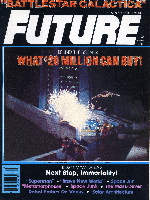
Next Stop, Immortality

Next Stop, Immortality

by Robert Anton Wilson

 from Future Life #6, Nov. 1978

According to the actuarial tables used by insurance companies, if you are in your 20s now you probably have about 50 years more to live. If you are in your 40s, you have only about 30 years more and if you are in your 60s your life-expectancy is only about 10 years. These tables are based on –averages, of course – not everybody dies precisely at the median age of 72.5 years – but these insurance tables are the best mathematical guesses about how long you will be with us. Right?

Wrong. Recent advances in gerontology (the science of aging, not to be confused with geriatrics, the treatment of the aged) have led many sober and cautious scien­tists to believe that human lifespan can be doubled, tripled or even extended in-definitely in this generation. If these researchers are right, nobody can predict your life expectancy. All the traditional assumptions on which the actuarial tables rest are obsolete. You might live a thou-sand years or even longer.

Of course, science-fiction people are just about the only audience in the country not staggered by the prospect of longevity. We’ve been reading about it for decades, and such superstars as Heinlein, Clarke and Sirnak have presented the subject very thoughtfully in several novels. But . . . longevity in this generation? In lecturing around the country on this topic, I have found even some SF freaks find that a lit­tle far out.

Well, consider: all aspects of research on longevity are accelerating and there has probably been more advance in this area since 1970 than in all previous scientific history. For instance, when I first wrote an: article on this subject in 1973, the most op­timistic prediction I could find in the writings of Dr. John Bjorksten, one of the leading researchers, was that human: lifespan might soon be extended to 140 years.But only four years later, in 1977, Dr. Bjorksten told the San Francisco Chronicle that he expects to see human life extended to 800 years.

This does not merely indicate that Dr. Bjorksten’s personal optimism and en­thusiasm have been increasing lately: he is reflecting the emerging consensus of his peers. Dr. Alex Comfort, generally regarded as the world’s leading gerontologist by others in the profession (although better known to the general public for his lubricious Joy of Sex books) said recently, “If the scientific and medical resources of the United States alone were mobilized, aging would be conquered within a decade.” (Italics added.) That means most of us have a good chance of living through the Longevity Revolution.

Similarly, Dr. Paul Segall of UC-Berkeley predicts that we will be able to raise human lifespan to “400 years or more” by the 1990s. Robert Prehoda, M.D., says in his Extended Youth that we might eventually raise life expectancy to “1,000 years or more. Hundreds of similarly optimistic predictions by researchers currently working in life extension can be found in Albert Rosenfeld’s recent book,Prolongevity.

Expert opinion on longevity has grown steadily more optimistic every time it has been surveyed, because the lab results are better every year. In 1964, a group of scientists was polled on the question and predicted chemical control of aging by the early 21st Century. In 1969, two similar polls found scientific opinion predicting longevity would be achieved between 1993 (low estimate) and 2017 (high estimate.) Dr. Bernard Strehler, one of the nation’s leading researchers on aging, predicted more recently that the breakthrough would occur sometime between 1981 and 2001.

At the March 1978 Alcor Life Extension conference in Los Angeles, some of the experimental results justifying such forecasts were presented. Dr. Paul Segall reported on work in which he had increased the lifespan of rats to double the normal, with some evidence of rejuvenation as well. Dr. T. Makinodan did even better with ex­perimental fish, tripling their lifespan. Dr. Benjamin Frank reported a slowing down of aging in human subjects given nucleic acids.

The Russians have even claimed that the breakthrough has already been made. In August 1977, Dr. Sukharebsky and Dr. Komarov predicted that their current work would raise human lifespan to “400 years and even more.” Two months later, in Oc­tober 1977, two other Russian scientists, Dr. Mekhtiev and Dr. Mine, claimed to have stopped the aging process in 25 ex­perimental human subjects.

Even cryonic freezing – the long-range gambler’s approach to longevity, when it started in the 60s – Is advancing by leaps and quantum jumps. An October 1975 McGraw-Hill poll found the majority of experts in the field believed cryonic freezing would be perfected and perfectly safe by 2000. Dr. Paul Segall, since then, has several times brought back to life cryonically frozen hamsters — animals which were, by all life-function readings, “dead” during their freezing. Not only were the hamsters’ hearts not beating (the 1960s“definition of death) but even their brain waves stopped (the 1978 definition of death); yet, after revival, they were as frisky and playful as if they had just had a good nap.

The full impact of the Longevity Revolution can only be grasped by con­sidering the “extremists” in the field-those who are aiming beyond life exten­sion to physical immortality. Albert Rosenfeld, science editor for Saturday Review, devotes a whole chapter of his Prolongevity to these Immortalists (as they call themselves) and he does not treat them with contempt. Among the leading Immortalists are Dr. Paul Segall (already mentioned several times here), novelist Alan Harrington, a Christian clergyman named A. Stuart Otto, who heads a group called The Committee for the Elimination of Death, and the ever-controversial Dr. Timothy Leary, who is currently touring the college lecture circuit preaching life-extension with the same fervor he once gave to consciousness expansion.

Some of the mainstream longevity researchers also seem to be closet Immortalists. Dr. Bernard Strehler, for instance; usually talks only of life-extension, but in art interview with Rosenfeld he stated flat­ly, “Man will never be contented until he conquers death.”

The basic Immortalist argument runs as follows. Be as conservative as you like in estimating the probable life-extension breakthroughs of the next two or three decades. Assume the relatively tame prediction made by Dr. Bjorksten back in 1973, when this research was (by com­parison with its present status) in its infan­cy. Say that Bjorksten was right then and we can only expect to see lifespan increas­ed to 140 years in the near future.

But this means that, if you are in your 40s, you will probably not be hauled off-stage by the Grim Reaper in 2008, as the insurance companies are betting. You will probably still be here in 2078. And if you are in your twenties or younger,: you have a good chance of being around until 2098.

But if you will be around that long, what will happen in the meanwhile?

Even if the current predictions of such learned scientists as Dr. Segall, Dr. Prehoda and Dr. Komarov projecting life spans of 400-1000 years – are a generation premature, two generations premature or even three or four generations premature, still, you have a good chance of being here when these dreams are achieved.

In short, even if we can only double lifespan in this generation, we will still be around when further breakthroughs will probably triple it, quadruple it or raise it into millenniums.

And then some of us will be here when the next quantum jump in lifespan occurs, and the next, until Immortality is achieved.

Longevity, Rosenfeld says, means “to have time to travel everywhere, and, go back again and again to favorite places. To go on learning – new skills, new sports, new languages, new musical instruments. To undertake a variety of careers and a diversity of relationships, for some, perhaps, a diversity of marriages. To read everything you want to read. To listen to all the music. To look at all the pictures and even paint a few. To savor and re-savor experience and arrive, not at boredom, but at new bevels of appreciation.“

Well, yes, but that’s only part of what longevity offers. It means, also, to live through more scientific and technological breakthroughs than humanity has ex­perienced in its whole history. (After all, every branch of knowledge is increasing at an accelerating rate these days.) To live through the Age of Abundance predicted by Buckminster Fuller, when Space Industrialization ends the Malthusian crunch of planetside living and poverty disappears once and for all. To be around when physicists tap the zero-point energy and give us Super-Abundance. To see the consciousness revolution of the 60s blossom, as Tim Leary predicts, into an intelligence revolution, as we learn to program our nervous systems as efficiently as we program computers. To see a world without stupidity, poverty, neuroses and war; where the human brain will at last function smoothly, efficiently and ecstatically, to solve problems, maximize personal growth and enjoyment, free itself of implanted limitations and fears.

To live in O’Neil’s space towns arid space cities and then to move on, with the next expanding wave, to the stars. To meet new friends, as human-dolphin, human-primate and human-extraterrestrial communication leap forward. To have unlimited space, unlimited time and unlimited consciousness to enjoy space and time.  Possibly to see time-travel achieved and share in its fallout, Immortali­ty, when we can go anywhere in the past or fatale, stay as long as we want, and come back to the moment we left.

There is no Utopian scenario we can dream of for our descendants that cannot be ours, too . . . if the Longevity Revolu­tion is made our top national priority. I can’t see why anything else should be a higher priority: there’s nothing more worth living for than life itself. A crash project, similar to the Atom Bomb race of the 40s or the Space race of the 60s would certainly produce dramatic results within a decade. (We had the A-bomb five years after Roosevelt made it a national priority, the first man on the Moon eight years after Kennedy made that our goal.)

We have spent billions on Death since the cold war began 31 years ago; it is time we spent an equal amount on Life.

After all, if reading science-fiction is so much fun, wouldn’t living it be even more of a turn-on?

(submitted to RAWilsonFans.com by RMJon23)

Illuminatus! Play Interview

immortalistilluminatus

The ILLUMINATUS! Play Interview

(This interview conducted in March of 1977 first came across my radar in an odd little ‘zine, Weird Trips, Issue #2, 1978.  I later rediscovered it in the infosphere via James Nye.  Apparently it originates from a “fanatic supplement” dual titled “Illuminatus!” and “Immortalist,” that was distributed for the National Theatre run of the play. It was later published in Sphinx Magazine , Issue No. 1, 1978.)

Fortean Times issue 17 (August 1976) announced on page 23 that Ken Campbell (Honorary Member of the Isle of Wight Fortean Society) had written a cycle of five plays based on the Illuminatus! trilogy, and that from 23rd November there would be a different play (each consisting of five 23 minute acts) each night from Tuesday to Saturday, with the entire cycle being performed on the Sunday in a “bum-numbing marathon.” The cycle was performed at the Liverpool School of Language, Music, Drama and Pun at18 Matthew St,Liverpool. “Ken assures me,” FT continued, “that the plays will make brains boggle, and will be the biggest thing in the theatre for some years. If you can, read the novels before you go, so you won’t miss any of the intricacies or paranoia.”

The same issue of FT contained a review of the Immortal Trilogy on pages 26 to 27, which I quote in full:

A rambling story that trips through the Kennedy assassinations; a plot to release a heinous Anthrax-Leprosy virus; the notorious Chicago convention; how Hagbard Celine, the last of the freebooters, bought the Mafia with gold looted from an Atlantean temple; how ‘they’ shot a fake John Dillinger, leaving five colones on the loose; a revolution on the small island of Fernando Poo inspired by the minions of Chthulu; a whole regiment of Nazi stormtroopers in suspended animation on the bed of a Swiss lake awaiting activation by a rockgroup bent on world domination. Meet talking dolphins; Adam Weishaupt, who founded the Illuminati in 1776 (yeah! on 1st May, too) then fled to America when the sect got busted, changing his name to George Washington, and tending his huge marijuana plantations (why d’you think he looks so stoned on the dollar bill?) Padre Pederasty who recruits for numerous anarchist movements all using each other as cover; Atlanta Hope who uses her frightful anti-porn female militia, God’s Lightning, as one of the outlets for he operations as an Illuminatus; and many other cranks, dreamers, liberators and their victims.

This is a compendium of madness culled from all the key books of the (what used to be underground) culture on everything you can milk or laughs or shudders – drugs, sex, black magic, sex, comix, sex, horror & fantasy, sex, secret societies and even sex – written into a gut-busting, brain-withering riot guaranteed to become a cult novel (Tolkien will be spinning in his grave) and packed with enough paranoia to keep you glancing furtively over your shoulder for weeks. The authors prove the penis [sic] mightier than the sword on a philosophical battleground that draws on Lovecraft, Leary, Hassan-i-Sabbah, Kesey & Ginsberg, the Tzu brothers (Lao & Chuang), the Zen masters, Crowley & Levi, and other apostles, true and false, in the ancient conflicts between orthodoxy and unorthodoxy, the state and the individual, establishments and iconoclasts, us and them. Is the world really run by the Illuminati, and are a confused bunch of dope freaks really our last chance? Who is the lama who lives belowDealyPlaza and juggles with space-time? Why do our heroes stand by while a giant leviathan makes love to their computer? Is there any truth to the significance of the numbers 5, 23 and 33, upon which the entire novel is structured? (Be prepared for streams of consciousness in which not only identity but time and space no longer confine the narrative, which zips up and down time-lines and flashes into other minds with consummate ease.)

A damned good read. Has to be read to be believed (and even then I’m not sure – it really is preposterous in parts). See if you can spot all the allusions. Though Fort has only one fleeting mention that I can remember, the authors are fully aware of the Fortean philosophy, and indeed, the scope of the book is a brilliant exercise in Fortean flexibility, and an outrageous mirror of modern folly.

I think they liked it – and so have thousands of readers ever since. These pages are dedicated to the two Bobs’ Immortal Trilogy and the legendary Ken Campbell stage production, and are mounted in the hope that the show can be resurrected, so that those of us who love the book, but were just too young to go to the play, can at last catch up on what we missed. And if anyone thinks they might like to make a film of it too, that would be nice. My hope is that Daisy Eris Campbell, who is currently studying for an MA in production, and who owes her existence to the show where her parents Ken Campbell and Pru Gee met, will mount a production in time to celebrate the book’s 30th anniversary in 2006.

For the National Theatre run of the show (which included fantastic sets and design by Bill Drummond, who went on to become art terrorist and mainstay of leftfield pop-band KLF [a name, along with JAMM -Justified Ancients of Mu Mu – taken from the novel]), John Mackay and Heathcote Williams produced an Illuminatus/Immortalist ‘fanatic supplement’. It was designed by Richard Adams, with photos by Alan Bell and H. Murphy. Reproduced below are some pictures from that supplement, plus the interview with Robert Anton Wilson and the late Robert Shea. Robert Anton Wilson’s daughter had tragically been killed by thieves during an attempted robbery four months before the interview took place. Robert Anton Wilson movingly describes the efforts he and his many friends made to preserve Luna so that she might have life in the future. The interview also reflects Bob’s interest in life extension and immortality, the subject of the flipside of the supplement.

Bob Shea and Robert Anton Wilson are the authors of the 800-page SF epic, Illuminatus! Its subject is the history of the human race and the cloven-hoofed barbarism of contemporary politic. It’s no exaggeration to call it the foremost work of anarchist fiction to date. The interviews which follow took place inLondon in March 1977 on the occasion of the opening at the National Theatre of the 8-and-a-half hour stage version by Ken Campbell and Chris Langham’s Science Fiction Company ofLiverpool.

Fanatic: How far is Illuminatus a work of fiction and how far is it a work of fact?

Bob Shea: An intelligent person who looks at it will immediately recognise that it’s a put-on. But then there’s another level beyond that, where the fantasy blends in with the reality to the point where it’s not that easy to determine whether you’re being put on or whether it’s real. I myself keep changing my judgement about which parts of the book are real and which parts are fantasy.

Fanatic: Has anything happened since you finished the book to confirm you in your uncertainty?

Bob Shea: Yes, there have been a number if things that seem to bear out the direction we were going in: the discovery of the link between the Mafia and the CIA and their attempt to assassinate Castro. The existence of the informal international organisation of financiers called he Bilderbergers, who meet once a year and seem to determine the financial fate of the earth. The Trilateral Commission, similar to the Bilderbergers, headed by David Rockerfeller. This Commission seems to have membered at least two recent presidents of the US. The symbol of the Trilateral Commission is a triangle and the symbol of the Illuminati is an eye in a triangle. So as soon as I heard of the Trilateral Commission I couldn’t help but wonder if it wasn’t the Illuminati at work again! Then there’s the groups in Illuminatus that seemed to foreshadow little suicidal terrorist groups like the Symbionese Liberation Army.

Fanatic: What about the curious, rambling structure of the book?

Robert Anton Wilson: What we were trying to get away from was the assumed omniscience which writers have employed in the past. Nowadays, scientists admit they don’t know everything – there’s more than one model for what’s going on – on the subatomic level or the cosmological level. Liberal clergymen will admit their religion is not necessarily the only true one. And yet novels are written as if there’s at once a level at which the novelist knows everything. And the reader is just supposed to accept it. What we’ve done in Illuminatus! is to give several versions of reality and let the reader decide for himself or herself which one is the most believable. And then people ask us which is our real explanation. Our answer is we don’t know any better than anybody else. Everybody should think for themselves.

Fanatic: What about the book’s attitude to authority?

Robert Anton Wilson: The major song at the close of the play is, ‘Now Look What You Made Me Do!’ The phrase comes from Laurel and Hardy. Hardy does something completely asinine and then he turns toLaureland says, ‘Now look what you made me do!’ We’ve built that into the book as a sort of paradigm of the sort of things that go on in authoritarian, pyramidal societies, where everybody is looking upwards to get orders. Most people, if there are no orders coming, don’t know what to do and they sit around waiting for the next order, We’re trying to cure people of that ‘Now-look-what-you -made-me-do!’ reflex. It caused Buchenwald, Belsen,Hiroshima,Vietnam, the Crusades, the Holy Inquisition, the conquest ofMexico. As Gurdjieff said during the First World War: ‘It’s obvious that everybody on this planet is asleep. If those men were to wake up they’d throw their guns down and go home to their families right away.’ In addition to the play and the books, there’s an organisation known as the Discordian Society which is distributing cards making every man, woman, and child on the planet a Pope. We want everybody to recognise their own divinity and infallibility and stop looking outside themselves for orders.

Fanatic: Hagbard Celine, the book’s Discordian superhero, says – and it’s among the closing lines of the play: ‘Life on earth remains a tragedy as it ends with the death trip. My next projects are a starship to find some sane minds in this galaxy , and an immortality pill to end the death trip.’ Bob Wilson, You’ve become very involved in what’s become known as the Immortalist Movement. In theUSbooks seem to be coming out all the time with titles like Superlongevity, Man Into Superman, and No More Dying. How did you first get into the immortalist concept?

Robert Anton Wilson: Curiously enough, Bob Shea was the first one to start turning me on to the concept. At the time, in the mid-sixties, I couldn’t see any point in it. It seemed to me that it was at least a generation premature. It was such a long shot and so damned expensive. Nobody could afford cryonic suspension, as it’s called, except the very rich. Then in 1973 a whole bunch of weird things happened.

I began to have the impression I was receiving communications from Sirius, the double star nine light years away. [Timothy] Leary began to have the idea he was receiving extraterrestrial communications. And there was a whole bunch of weird synchronicities involving Uri Geller and some physicists I know. My Sirius experience started on 23 July 1973. The fact that it was on the 23rd blew my mind, because 23 has tremendous importance in Illuminatus. 23 has been a big number for me for some time.

Fanatic: This happened after you’d finished the book?

Robert Anton Wilson: We finished the book in 1971. On 23 July 1973 the Sirius thing began. Then I found 23 July was the day the Egyptian priests started all their rituals to Sirius, which continued until 8 September. These days were known as the days of the Dog Star, Sirius. I started getting these Sirius flashes before I knew about that. It was all so Jungian and weird that I began to think it was more than synchronicity, and that there was real communication going on and that I had tuned into it – into an interstellar ESP channel. As a result of the mental transformations I went through, I started developing pre-cognition and a heavy level of ESP. I found myself projecting to other parts of the country. All these things confirmed that it wasn’t just my imagination. I had objective evidence that I was seeing the future. I began to think through my experiments with certain kinds of kabbalistic magic. I had hooked into some real occult tradition that’s been going on since Ancient Egypt, that involved contact with extraterrestrials.

I abandoned that model around October 1974 when I developed a series of better models for the experience, in which I decided that I was turning on to higher circuits of my own nervous system. Unable to accept I was doing it all myself, I had to project like shamans usually do. I began to see that what Don Juan calls his allies – the Holy Guardian Angel of the kabbalah, my extraterrestrials – were symbols of the right lobe of my brain. I saw it that way until 23 July 1976, at which point I decided to do another experiment to see if I could get back in touch with Sirius. I re-entered the belief system, as John Lilly would say, that the extraterrestrial thing was real and working within that system. I did rituals to contact Sirius again and get objective evidence that it was really happening. Then, the next week, Time magazine had a full page review of The Sirius Mystery by Robert Temple. I immediately went out and bought it and found that he’s got tons of evidence that some kind of contact did happen around [the time of] ancientEgypt. He thinks they came here in a space ship. I think it’s more likely that techniques of interstellar ESP were worked out. As we say in Illuminatus, if you open your own eye fully you can see with every eye in the Universe. But I repeat that this is only one model of the experience. I agree with John Lilly and Aleister Crowley that you shouldn’t be satisfied with any one model. What’s going on is beyond our present concepts and, whatever model you use, you should regard it as tentative and temporary.

The whole explosion that was going on in ’73 involved a lot of weird synchronicities. Geller was working with these physicists I know who had their minds thoroughly blown. Mysterious hawks kept manifesting round Geller – the hawk Horus. None of these people were aware ofCrowley’s prophecies about the hawk-headed god who would manifest in the 1980s. One guy inTexasclaimed he was teleported thirty miles in his car – car and all – by Geller. A hawk appeared circling around the car right after that. A physicist I know called Saul Paul Sirac took LSD and went to Geller’s apartment and said: ‘Can I see the extraterrestrials while I’m on LSD?’ Geller said: ‘Look into my eyes.’ He looked into his eyes and Geller’s head turned into the head of a hawk. And he didn’t know about the guy inTexas, and he didn’t know that Puharich had been followed aroundIsraelby a hawk when he first visited Geller!

Fanatic: Can you describe what you experienced from when you woke up in the morning that day on 23 July 1973?

Robert Anton Wilson: I keep a magic diary by my bed to record whatever is left over from my dreams as I wake up. That’s a diary in which I record all of my consciousness-expanding experiments, whether with drugs, ritual, yoga or in dreams.

Fanatic: A hypnagogic diary?

Robert Anton Wilson: Not just that. I record things that happen in rituals, subjective and objective, what happens on an LSD trip – all sorts of right lobe activity. That morning I woke up with a very strong message and I had to get it down right away: ‘Sirius is very important.’ That was the beginning of it. I’d done a very powerful ritual the night before.

Fanatic: Could you describe that?

Robert Anton Wilson: The ritual was Aleister Crowley’s Invocation of the Holy Guardian Angel, with all the accessories to make it as powerful as possible. In other words, I was having sex and stoned out of my head while I did it. All the ritual was memorised and recited inside my head – with vivid visualisations, the way you learn to do visualisation in any school of kabbalistic or other magic. The same day I picked up Tantra, the Yoga of Sex by Omar Garrison, which I’d started earlier. I started looking at it again and found a passage in which he says that there are two sex cycles: the female was 28 days and the male was 23. So there as another 23 added to the synchronicity. I thought, ‘Gee, between the 23 and the 28 is the Discordian 5 that runs all through Illuminatus! My fantasy life is coming at me from books and dreams and everywhere!’

Fanatic: Could you explain what Sirius is?

Robert Anton Wilson: Sirius is a double star. Sirius A is the brightest star in the sky. You find it by looking down the Belt of Orion. It’s the brightest star that the Belt of Orion points to – the brightest star in the Southern Sky. Sirius B is invisible to the naked eye and wasn’t discovered by telescope until a few decades ago. It wasn’t successfully photographed until 1970. The odd thing about Sirius B, whichTempledocuments in his book, is that there are unambiguous, no-doubt-about-it references to it in the mythology of several African tribes. He has demonstrated by inference, and I think correctly, that the Egyptians knew about Sirius B too. He believesIsiswas the symbol of Sirius A, and Osiris of Sirius B, and that’s the meaning of the old secret of the Eleusinian Mysteries: Osiris was a black god. Sirius B is a dark star, a collapsed white dwarf which is in the process of evolving into a black hole.

Fanatic: What do you think is the significance of Sirius?

Robert Anton Wilson: It could well be a red herring. It could be our own minds developing and we need to have some kind of entity that we can project all this on to. It could be that their are no ‘allies’, no Holy Guardian Angels, no extraterrestrials at Sirius. But there’s a whole chain of amazing coincidence. A guy I know named Neo Wilgus, who’s done another book on the Illuminati which is coming out soon, said that while he was researching it he couldn’t go into a bookstore without picking a book up and opening it at a page which referred to the Illuminati. That happened to Shea and myself while we were writing Illuminatus! Once I got into the Sirius thing it kept happening. I went into a bookstore and looked at a book by J.F. Bennett called Gurdjieff, Making aNew World. I opened it at random and found this passage where Gurdjieff talks about the hidden references to Sirius in Beelzebub’s tales to his grandson. I said, ‘What! Gurdjieff is making hidden references to Sirius – why?’ Then I found hidden references inCrowley’s work that Kenneth Grant talks about. There it seems much more that synchronicity. Grant says thatCrowleywas in contact with extraterrestrials and that Sirius was the Silver Star that’s referred to in a lot ofCrowley’s poetry – the Argentum Astrum [also the name ofCrowley’s secret magickal order].

Albert Pyke, who was a 33rd degree mason, and the highest ranking mason in theUnited Statesin the 19th Century, says in Dogma and Ritual of Freemasonry that the Silver Star of every masonic lodge is Sirius. He doesn’t explain why. I kept running into things like that, and the communications got stronger and stronger. I tried experimentally entering other belief systems. I decided to take the most far-out belief system I could pick up, which was that færy people really exist. As nobody believes in færies anymore – it’s funny you kept pointing out James Barrie’s place this morning – they’ve got to get in touch with us some way. So nowadays they’re pretending to be extraterrestrials, I entered that belief system, took some acid, and went to a witches’ sabbat. I belong to three different orders of witch covens inCalifornia. When we did the Raising of the Cone of Power I got really spaced out and a bunch of fairies came and took me to færy land. I went through the classic thing of La Belle Dame Sans Merci and all the classic Celtic lore, including time warps. The phenomena adapt to your belief system. If you believe there are no such phenomena, the phenomena adapt to that. I know people, intelligent people, who tell you there’s no such thing as ESP and they’ve never experienced it, whereas I guess 80 percent of the population has had some ESP experience.

Fanatic: I always ask such disbelievers what thought they’re going to think three thoughts from now – that gets ’em! Do you think fairy rings are connected with UFOs?

Robert Anton Wilson: Of course. Fairy rings are the burn marks from UFOs. I’m not the first one to have seen the link between fairies and UFOs. You can use any model you want. You can say it’s fairies or UFOs or time travellers if it fits into your belief system. You can decide it’s the kabbalistic Holy Guardian Angel, or you can decide it’s all your own nervous system developing its latent powers.

Fanatic: Apart from the incidents of synchronicity, what other things have occurred to you to indicate there are presences on Sirius?

Robert Anton Wilson: I’ve had voices speaking to me and telling me things that turned out to be true.

Fanatic: Different from your own inner voice?

Robert Anton Wilson: Yes. Very definitely.

Fanatic: A different tone, a different accent?

Robert Anton Wilson: Yes, a separate voice.

Fanatic: Speaking English?

Robert Anton Wilson: Yes.

Fanatic: With an American accent or an English accent?

Robert Anton Wilson: Now that’s odd. I guess it’s a Canadian accent if you really want to tie it down, or upper class middle American – something like that. Not very strongly accented. I’ve had the experience of seeing across space and time simultaneously, seeing something that happened half an hour later in another part of the city, and I’ve had the experience of being in California and Arizona at the same time, and being in California and seeing things in Arizona that were apparently affecting them. As if I were inArizona.

Fanatic: Was that in an every day context?

Robert Anton Wilson: No, that was at another witches’ sabbat. If anybody had told me things like this five years ago I would have said they were nuts. Meanwhile Leary got an extraterrestrial transmission that we can achieve immortality in this generation. I got involved with a bunch of biologists who are into life-extension research. They break down into two groups: one large group who believe we can have longevity in this generation and are working really hard at it. They’ve been at it so long and got sufficient respectability that those who disagree with them are now disagreeing very politely. It’s a respectable position to believe that longevity is possible. The belief that immortality is possible is still confined to a small minority. I got involved with a lot of the immortalists who are, I think it’s objective to say, some of the brightest people in biology. It doesn’t mean to say they’re right, and it’s not special pleading when I say that – the brightest people are often wrong. The brightest people are the most far-out and they may be right are wrong.

Fanatic: Your 15-year-old daughter, Luna, was murdered four months ago. Could you describe what happened?

Robert Anton Wilson: Luna was beaten to death in the course of a burglary at a store where she was working. Right after Luna’s death I got a call from Paul Segal, who’d just got his PhD for research in stopping the ageing process in rats three different ways. He acknowledges me as one of the people who helped him in his work. I didn’t do any of the research, but he felt I’d contributed a lot to his work. Paul said he knew I didn’t have the money to pay for cryonic suspension, but he said we could get it done voluntarily and funds for the upkeep could be raised later. It turned out that a lot of people in the Immortalist Movement were chipping in to help out and so on. So we had Luna preserved. All the work was done by the Bay Area Cryonic Society voluntarily as an expression of gratitude for the publicity I’d been giving their work. It’s probably the most deeply moving things that had happened to me in my whole life. There was a real anxiety that we couldn’t do it because of all the legal red tape. We were very fortunate. As soon as we approached the coroner he immediately understood the idea and did everything he could to help us.

Fanatic: But isn’t cryonic suspension extremely costly?

Robert Anton Wilson: It’s beyond the means of an ordinary person today. It’s available only to the very affluent. It’s a question of getting together sufficient capital to pay for the thing – and for an indefinite period of time out of the interest – which requires around 30,000 dollars. Part of the reason we’re doing a Luna Wilson immortality fund-raising affair in Berkeley in April, with Leary Eldridge Cleaver and Ken Kesey, and various rock bands, is to raise funds for Luna’s storage – and the rest of it will go into cryonic research.

Fanatic: There’s a persistent story that Walt Disney was one of the first to opt for cryonic burial . . .

Bob Shea: One version of the rumour is that he’s in a permanently locked chamber in Snow White’s Palace inDisneyland, because people have seen hoar frost coming from under the door.

Robert Anton Wilson: The Disney Organisation always denies it. But it is a fact that before he died he made a series of films, one of which is shown each year to Disney executives as a kind of pep talk. And at the end of each film he says, ‘I’ll be seeing you’ – which could refer to the next film, or it may have referred to the fact that he is cryonically suspended.

Fanatic: Alex Comfort [author of The Joy of Sex] is one of the world’s foremost gerontologists. He’s also an anarchist and he lives inCalifornianow. What’s his attitude to the Immortalist Movement?

Robert Anton Wilson: Comfort has not endorsed immortality yet, but he’s one of the leading propagandists for longevity. He’s certainly convinced longevity is possible, maybe as soon as the 1980s. We’ve got enough good theories. Immortality is possible, and longevity is a damned good probability. The question is, How soon? That depends on how much funding is available for research, and that depends on how much public excitement we raise over the issue. There are different estimates – like maybe it’ll come in the late 1980s if we get enough people excited enough an yelling: WE WANNA LIVE LONGER! I think he’s right, so I’m agitating as much as possible to get more and more people into longevity.

Your attitude to it changes as you get older. I’m 45. One of the people I know who’s most dedicated to the whole thing is 67. If it’s coming around the year 1992, let’s say, it doesn’t make much difference to people in their 20s whether we hurry or not. As you get older, the idea of hurrying gets more and more important, especially if you’re going through what I’m going through, where you begin to realise you don’t know anything. When you being to realise that the universe is much more mysterious than you ever knew, that something is going on of which synchronicity is just the edge; that there seems to be a higher intelligence or higher intelligences – whether we think of them as angels or extraterrestrials, or time travelling anthropologists from the future or whatever – it’s obvious that our ordinary consensus belief system is inadequate. I’m not overly impressed with a lot of the professional wise men around – gurus and so on. I don’t think they know much more than I do, and so I have this tremendous sense of mystery and curiosity and I think it’s a damn shame that people get shoved under before they live long enough to develop this sense of mystery.

Right now I’m more excited about life and its mysteries than ever before, and I’d like to live long enough to find out what the hell is going on. J.B.S. Haldane said: ‘The Universe is not only queerer than we think, but queerer than we can think’ – especially when you’ve mutated to the neurological level, where you start getting what Leary calls ‘Sixth Circuit’ experiences. Everything I’ve been describing, Leary calls the Sixth Circuit.

Fanatic: Meaning what?

Robert Anton Wilson: Leary posits eight circuits. The First Circuit being simple bio-survival – being aware go dangers to your body and the way you can get nourishment, the way babies are oriented. The Second Circuit is mammalian politics -status and territory. And the Third Circuit is symbolic – that’s the one I’m doing right now: yakkity-yakkity-yak. The Fourth Circuit is the sexual circuit, and the Fifth Circuit is the rapture circuit or tantric circuit, where you can turn on to pure bliss. The Sixth Circuit he calls neuro-electrical, and that’s where weird things start happening. Above that there’s the Seventh and Eighth Circuits. When you get to at least the Sixth Circuit, asCrowleysays, the Universe becomes a more or less continuous ceremony of initiation. There’s synchronicity everywhere, there are miracles everywhere. Everything is much more puzzling than it ever was before. At this stage I just want to live as long as possible in the hope that I’ll eventually figure out what the hell’s going on.

Fanatic: What are the social and political implications of infinite life extension?

Robert Anton Wilson: It’s the most revolutionary concept that’s ever hit this planet. You can’t think of anything in our society that’s not going to be changed by it. What’s going to happen to the insurance companies? What’s going to happen to the banks when people go on living long enough to collect compound interest for a couple of hundred years? What are we going to do about the prison system? Prisons are desperate places already. People are going to live, let’s say, three hundred years. We’re going to have people in and out of prison continually, and every time they come out they’re a little crazier and more violent than when they went in. Think of that going on for three hundred years!

Fanatic: But isn’t there a potentially sinister side to the Immortalist idea? Can’t it also be seen as the logical extension of the Forest Lawn death trip – a symptom of a death-oriented society in a late stage of decay? The ultimate in terms of capitalist exploitation would be to charge people to breathe; at present that isn’t a reasonable proposition. When cryonic suspension achieved low unit-cost, it could be the next best thing: charging people for maintaining their bodies after physical death – an immense source of revenue for big corporations.

Robert Anton Wilson: Yes, people I know who are heavily into the immortalist trip are very aware of that. Paul Segal, to whom I referred earlier – he’s frozen the four people who’ve been frozen in the Bay Area – he’s very aware of that. Paul actually belongs to a radical group called Earth People’s Commune, which is very Marxist oriented, anarchist-Marxist. The threat is there. But what Paul’s most excited about right now is bringing down the cost of cryonics so anybody can afford it. He thinks that within five years they could bring the cost right down to make it available to almost anyone. But, in general, people in the immortalist movement are tremendously aware of problems like that. Leary’s approach to the whole thing is: Bring the message to the people. If enough people are turned on to it there’s no way it can be monopolised, because everyone will be demanding it. The only way it could turn into a really bad trip is if the Rockerfellers got hold of the formula and wouldn’t let anybody have it but themselves; so we’d have an immortal ruling class going on forever, and everybody else being mortals. It would be the ultimate horrors of capitalism carried to the extreme. But that can’t happen, because too many of the researchers are of a political persuasion where they just won’t let it happen. The people who are doing the scientific work aren’t going to let anybody monopolise it. They’re going to make damn sure that when they get the longevity formula, the pill will be available to everybody.

Fanatic: From what you’ve been saying, it’s clear that people like Leary and yourself are fairly confident human life exists in multiple dimensions – a notion consistent with conventional religious ideas of immortality. If humans continue to exist in other dimensions after physical death, why is it necessary to place such importance on immortality in the comparatively mundane physical sense?

Robert Anton Wilson: As Sinzaki Roshi said when he was dying of cancer, one year of life is wonderful, a hundred years of life is more wonderful.

Fanatic: Doesn’t what you’re saying bespeak a lack of confidence in the traditional notion of immortality?

Robert Anton Wilson: I don’t think ‘lack of confidence’ is correct. ‘Lack of blind faith’ is the way I would express it. My attitude is that the Universe is so damned mysterious I don’t have any dogmas about it. I have a lot of reason personally to believe in survival beyond the body, but I don’t think the evidence is conclusive. I think there’s a good chance that there’s a lot of wishful thinking there. I’ve had memories of past lives under hypnosis – I’ve been regressed. My attitude still is that we don’t know. A lot of immortalists would disagree with me on this. I’m not speaking for the Immortalist Movement on this, but I think we may get a hell of a surprise in the next fifteen years. We may get longevity and the first step towards physical immortality and we may get absolutely conclusive scientific proof from the parapsychologists that we survive anyway! That’ll present us with a very interesting alternative. We can have physical longevity or we can accept death with the knowledge that it isn’t the end. And other things’ll be opening up too. It’s quite possible.

Norbert Wiener talked about this as early as 1948, and Buckminster Fuller was talking about it inSan Franciscojust three weeks ago – that we’ll learn to code the personality into electrical impulses. We could translate ourselves into computer! Now some people would regard this as the ultimate horror, but I think it might be an interesting trip – to be a computer for a while. Like on Star Trek – the transporter. We could take ourselves apart and put ourselves together in a different part of the Universe. There may be many types of immortality. As long as we don’t know, I’m eager to explore the possibilities. It would be a real gas if we get longevity and physical immortality, and at the same time we prove that there is some kind of spiritual immortality. That will blow everybody’s mind. What the hell will people find to worry about then? That’ll totally transform human psychology.

Fanatic: Are there any currently available techniques of longevity that seem to work?

Robert Anton Wilson: That’s very debateable. There are a lot of theories about it. There are people who live a lot longer. Allegedly, there are people among the Hunsas, and in parts ofRussia, and in one part ofSouth America. The evidence is still being debated. There’ve been studies made of their diet and so on. Actually, Baba Free John, who’s a guru of a particularly farout cult inCalifornia- you could call it a kind of hippie Zen – is very into longevity research. He says we’ve got to live several hundreds of years each before we can develop to our full potential. He says that the kind of enlightenment people have achieved in the past is only partial, and when we live several hundreds of years we can attain a higher level of enlightenment. So he’s set up a group called Incarnation Incorporated which is co-ordinating all the different approaches to longevity. . They’re also organizing expeditions to places where people are alleged to live longer, and really check them out. It’s not all scientific materialists who are into longevity. Baba Free John is really quite a traditional guru of the crazy sort. Crazy gurus are traditional too, you know.

Fanatic: What about crypto-biosis? Do you see any significance in the way seeds can lay dormant in the desert for years until there’s a shower of rain, or in Sea Monkeys, which have the same ability. They’re known asartemia salinia in Latin slang. They’re little brine shrimps that don’t seem to die. They just encyst themselves and then re-animate.

Robert Anton Wilson: A lot of things are coming down to the hologram theory of life: the whole in very part. Every part of a hologram contains the whole, and that’s the old magic law: the macrocosm is in the microcosm. It’s literally true that within one cell of your body there’s all the genetic information of your personality – the Universe in a grain of sand. In that sense, it may not be necessary to preserve the whole body. It may just be a kind of conservatism and timidity on the part of people who meanwhile think they’re very far out.

Fanatic: Talking of cells, could you say what you see to be the role of DNA?

Robert Anton Wilson: We think that DNA is an intelligent entity, more intelligent than any of us – it designed all of us. And we think that DNA has a definite project in mind – that is to say, immortality. I think that what it’s been working on all along is to produce immortal organisms which are capable of travelling off the planet – transcending the mammalian condition, the struggle for existence, and so on. And actually, to be blunt about it, become God-like beings. I think that that’s been the programme of life from the very beginning. I think it’s a good model or metaphor to regard DNA as a higher intelligence which had programmed all the life on this planet for three-and-a-half billion years. Hubert Muller, a Nobel laureate in genetics, once said that we were all giant roots created by DNA to make more DNA.

I think there’s a lot of truth in that metaphor. DNA is immortal and has designed everything. Bucky Fuller points out that there’s no engineer or technologist, including himself, who has achieved the simplicity and tremendous structural strength and economy as the average tree. DNA is the greatest technologist on the planet, and, as my son Graham pointed out, it’s the world’s greatest psychedelic artist. Just take a walk in the woods. I think scientific understanding of DNA confirms everything that the mystics have been saying for millennia about the higher intelligence that never dies, in the essence of all things. You can understand it scientifically, but to really experience it – that’s what Leary calls the Seventh Circuit of the nervous system – when you really turn on to the DNA and receive the genetic signals. Nobody who’s had the experience has been able to talk about it rationally.Crowley, said you can’t talk about it without raving like a lunatic. The closest expression we have to what it’s all about is the last movement of Beethoven’s Ninth Symphony.

Fanatic: The double helix is a spiral. The wand of Hermes/Mercury, the Caduceus, is a stick with two snakes spiralled around it. It’s the symbol of medicine in the Western world. There’s the spiral dance of the Dervishes, and the spirallingTowerofBabel. Do you see any connection between the mystic spiral and DNA?

Robert Anton Wilson: Sure. The ancient Chinese physicians use marijuana stalks carved in a spiral for healing. The kundalini has to be a spiral. It’s obvious that a certain number of people throughout history have turned on to the seventh circuit, and have reached that level of consciousness, and have left the symbols behind. You can find the kundalini serpent in Babylonian art as well as in Hindu art, and the witches’ dance is always an inward-turning spiral, like my ring here. It’s the way ancient Irish burial grounds were laid out. (Right, the Goddess Kundalini.)

Fanatic: Shea remarked earlier that the double helix is a spiral that’s out to screw us. Do you agree with that?

Robert Anton Wilson: Well, the DNA doesn’t give a damn about us. It uses us [as a vector] to reproduce itself. In many species reproduction is the beginning of death. That was in the biology book James Joyce had when he was in university, and it made a big impression on him: reproduction is the beginning of death. The salmon dies right after spawning; as soon as we reach sexual maturity, we start declining. The DNA wants us to reproduce and make more DNA, better DNA, and then it’s finished with us. In another sense, though, on a deeper level, I think the DNA has designed our nervous system, including the right lobe of our brain and all our higher faculties, to enable us to do what it can’t do. It’s much more intelligent that us but it’s much slower. It works in billions of years and it’s designed human beings to think faster and do things quicker, so that we don’t have to settle for the original programme. We can revise the programme. We can revise the programme. I think that we can find the trigger of the senescence process and turn it off. The biologists who think that senescence is the result of entropy really haven’t considered the thermodynamics of entropy. If senescence were the result of entropy, we’d find a random graph of people dying at 30, 70, at 103, 350, 400 – and so on. Instead we find a straight line at around 70. Almost everybody goes within a few years of that point. So it’s not a random stochastic process. It’s a definite kinetic programme. The DNA plans to kill us off after it’s used us. But it’s very obvious that we’re close to finding the chemical trigger and nullifying it. Nobody knows how long we can live. Everybody’s guessing really – it may be hundreds of years, it may be thousands.

Fanatic: But won’t immortality make reproduction superfluous?

Robert Anton Wilson: That’s not entirely clear. I’ve heard some people argue that the rising survival and birth rate in the past century, due to modern medicine and so on, may all be a DNA programme to prepare us for star travel, which may require many more human beings than have ever been on this planet before to get the show on the road – to get us blasting off for the stars. Leary thinks that. Like all modern scientists, he’s sceptical of his own theories. He wouldn’t insist that it’s literally true, but it’s one useful model – that because we’ve been thinking too much with the left brain, we’ve been creating ecological havoc on the planet, so that the DNA had to get new signals through to us . It did this through the vegetative kingdom which was being severely endangered by pollution and so on. So the vegetative kingdom conspired to get chemicals into us that would teach us ecological common sense. The only way to get them into our nervous system in vast quantities in a quick way is hedonistically. So the vegetative kingdom set out to seduce us with drugs that get us high and make us happy and at the same time open us up to right brain activity. You see, the Fifth Circuit is the sugar coating to get us into the Sixth Circuit. First it turns us on and gets us high, and then it opens us up to a more cosmic perspective. It’s all a vegetable conspiracy to communicate with us. The mushrooms and the cacti and the hemp and so on are signals from the vegetative kingdom to our nervous systems.

Fanatic: So DNA is using us to get DNA off the planet?

Robert Anton Wilson: That was the transmission Leary got in August 1973 – that the DNA wants to get off the planet and we’re the tool-making part of the DNA ‘brain’. Maybe our function is to take the trees to the centre of the galaxy? They may be the only ones who can communicate with the really higher intelligences. Our function may be to build L5-type space cities with whole micro-ecological systems, streams and fish and so on, and take them to the centre of the galaxy where maybe the trees or the dolphins will do the communicating?

Fanatic: It always struck me as very odd why Christ cursed the fig tree. Do you have any answers to that?

Robert Anton Wilson: No. Do you?

[I have a guess, which is that the fruit of the fig (full of seeds like the pomegranate) is a symbol of reproduction/fertilty – and therefore the symbol of the repetitive cycle of material birth/rebirth. This passage must be a remnant of the world/matter hating ‘Gnostic’ element in Christianity. There were other less negative, world-embracing Gnostics too. – Ed.]

Fanatic: Do you have any interpretation of the recurring Methuselah myth that there have already been members of the human race who’ve lived for hundreds of years?

Robert Anton Wilson: I think it’s possible. There was the case of Nicholas and Pernelle Flamel. He was an alchemist, and he and his wife lived for 120 years each. As far as I can gather from his records – like all medieval alchemists he wrote in code – they were using some kind of tantric practices to prolong life. Maybe others did even better. There are these legends about wise old characters in the East who are several hundred years old. I don’t believe it. I don’t disbelieve it either.

Fanatic: It could be certain members of the race located the technique in the past and it’s been lost track of?

Robert Anton Wilson: They located one technique possible, or maybe more than one. I think certain yogic and magickal practices probably do extend life somewhat, and maybe there are practices which extend it quite a bit. This is very speculative, of course.

Fanatic: Could you explain the concept of neurologic?

Robert Anton Wilson: In the next 30 years there are three major things which are going to happen and which I have three acronyms for. They were coined by a group of people I’m working with in California: Dr Timothy Leary, Dr Wayne Benner, Dr Jack Sarfatti, Saul Paul Sirac and others. First of all, there’s the SMI2LE breakthrough – Space Migration, Intelligence-squared, and Life Extension. Now that’s going to change everything. It’s the biggest mutation in history. It’s not an historical event, it’s an evolutionary event, the biggest since life came out of the water and onto the land. Intelligence-squared means the nervous system studying the nervous system. Learning how to reprogrammed your nervous system for different levels of functioning. Together with that, we’ve got what I call the HEAD Revolution – that’s Headonic Engineering and Development. We are learning how to stay high all the time. The yogis discovered that about 2000 years ago.

We’re learning how to do much of it more efficiently. The breakthroughs that have happened already are minor in comparison with what’s going to happen in the next fifteen years. For instance, just two years ago bio-feedback demonstrated how to control the function of the erection of the penis at will. Nobody’s been able to learn how to do that at will except very advanced tantric yogis. At Harvard and John Hopkins, they got 60 percent of the subjects to do it within a couple of weeks. Biofeedback is only part of the neurological revolution. LSD was the tip of the iceberg. The science of reprogramming the nervous system for ecstasy in the next fifteen years is going to be just as important as SMI2LE. You’ve got SMI2LE, and then you’ve got HEAD coming; everyone’s going to be high all the time. Along with that, there’s the RICH scenario: Rising Income through Cybernetic Homeostasis. RICH also stands for Recreation, Intelligence-squared, Creativity and Hedonics. With that we’re going to automate everything and people will be free to use their nervous systems creatively.

Aristotle said slavery can only be abolished when the machine can run itself [at the moment, we are the parts of the machine itself]. We’re getting to the stage when machines can run themselves, and manual labour, repetitious toil – all of the dehumanising, degrading, robotic functions will be taken over by machines, leading to a fantastic increase in the gross national product everywhere. Poverty will abolished by the year 2000, between RICH and SMI2LE. When we start bringing in free energy from outer space, we no longer have a closed system. We’ve got an open system of virtually unlimited energy. When you put SMI2LE, RICH and HEAD together you’ve got the highest standards of all previous societies: utopia. Utopia or oblivion – heaven or bust – those are the only two choices. I’m betting on Utopia, and all that is necessary is for these signals to keep bouncing round the planet for people to become aware of these potentials. All the preconditions are available. You can’t judge the future by the past. It’s always full of surprises. I would say there are more high, holy, happy beings around on this planet than ever before in history, and there are going to be four times as many by 1987. You’ve got to realise there’s a planetary explosion of intelligence and consciousness. We can still blow it – we can still choose oblivion, but that’s the only choice we have; Utopia or Oblivion. There are no compromises.

Fanatic: What the powerful call Utopia is now the condition for human survival.

Bob Shea: The point is to appropriate the technology and use it. It’s not something that’s just going to happen because the technology is there. Solar power from space colonies could be the private preserve of monopolies like General Electric, something to which everyone would then be imbonded. It’s going to come – something that’s absolutely necessary, so people have to prepare themselves for this development and begin to work to ensure that when solar power comes it isn’t like oil or gas – just another thing that enslaves people.

Fanatic: What do you think of the stage version of Illuminatus!?

Bob Shea: I think it’s superb. I was thunderstruck at what a magnificent job they did in capturing the exact tone, the exact mixture of fantasy and reality in the book. It really does keep you guessing, which is what we intended. I’ve come round to the conclusion that this isn’t literature. It’s too late in the day for literature. This is magick!

Fanatic: Presumably things have happened in the last few days that have confirmed that?

Robert Anton Wilson: Oh God yes! I don’t know about other people, but the most overwhelmingly powerful moment in the play is when Saul Goodman realises his guilt in sending people to the electric chair and the way they play it – going through it once without any emotion, and the with emotion. That happened by accident. The Xerox machine made two copies of one page and the actors found themselves going though it twice, and Ken Campbell said, ‘Wait! That’s good!’ So they got the idea of going through it once without emotion, and then again with emotion breaking through. I think it’s tremendously powerful. It’s direct intervention of the goddess. She always works that way. Every time something chaotic and unexpected happens, we Discordians say: Hail Eris!

Fanatic: What were your other reactions to that scene?

Robert Anton Wilson: It made me cry. I’ve always been against capital punishment, and that was one of the most deeply felt scenes in the book. It really came across on the stage the way I wanted it to. Since my daughter was murdered people have frequently asked me, ‘Are you still against capital punishment?’ And the answer is – absolutely.

Neurological Relativism

Neurological Relativism

by Robert Anton Wilson

from New Libertarian, March 1978

In my previous two columns, I have presented the case for the ultimate skepticism (i.e. solipsism) as strongly as I could, indicated that it not only can be defended on rigidly logical grounds (cf. Hume, David, works of), but also that is seemingly confirmed empirically by the practice of silent-level meditation.

Of course, I am not a solipsist. Having fathered four children in this highly competitive society, I have had to confront the nitty-gritty gut-level reality of the iron laws of economics in a manner and with a persistancethat makes me as much of a believer in “external reality” as any Marxist or Objectivist could wish.

I have even been on Welfare twice in my 45 years, for over a year each time. (It is a most educational experience and every libertarian ought to go through it, just as every Marxist ought to have the experience of running a business and meeting a payroll.) Nobody who has gone through the rituals of social degregation involved in falling from Associate Editor of Playboy to Welfare “case” (Americanus nondesirabilis) can be a solipsist. To get off Welfare and become affluent again, as I have also done, is an even better cure for solipsism; if I hadn’t figured out some of the laws of that part of the “external world” known as publishing, I would still be on Welfare.

Nonetheless, my skepticism does verge very close to the solipsistic extreme, and Mr. John Walker had ample excuse to wonder, as he did in NLW 93, how somebody as close to solipsism as I am does manage to deal with the external, sensory-sensual, existential world at all.

The answer is the same as Godzilla gave on Saturday Night Live when Baba Wawa asked him, “How do you and Mrs. Godzilla do it?”

“Very carefully,” said Godzilla. And that’s how I deal with “reality.”

As the result of the yogic and alchemical disciplines I have practiced during the last 15 years, I know that the solipsist position is the minimal truth, i.e., that all we really know is a stream of sensation. The common sense hypothesis that there is an Ego (“me”) observing/experiencing this stream, are unprovable, but denying them seems to lead to worse confusion than (tentatively) accepting them.

But I also know that everything I think I know about the Ego (“me”) and the External World (“it”) is woefully little, and very misleading (more “untrue” than “true”) because it is such a microscopic fragment of what the total Me and the total Universe must be. Blake said, wisely, that “Every thing Capable of being Believed is an Image of the Truth;” but it is also true, as Blake no doubt realized, that Every thing Capable of being Believed is Self-Hypnosis.

It is emperically known to me, through neurological experiment, that every time I manage to change to focus of my nervous system, a new Me appears, and a new External Reality, and that these mingle in curious ways, and each grows steadily bigger, weirder, more mysterious and more humorous as my researches proceed.

Artemus Ward put it this way: “The trouble with most folks is not that they don’t know enough but that they know so much that ain’t true.” Or, in the more slashing style of Neitzsche’s soaring sarcasm, “We are all much greater artists than we realize.” Whatever we know of Me and The Universe through the filter of our nervous system is much more of a record of the structural functioning of the nervous system itself than it is of the enormous mysteries of the real Me and real Universe.

That is why Discordianism is such a jolly flavor of nihilism. There is joy ineffable in freedom from fixed ideas, even if those trapped in fixed ideas cannot imagine such a state and dread it “as the devil dreads holy water.” Since I am mildly puzzled all the time, I am continously curious and hence passionately involved. I deal with the world “very carefully” because I respect its mystery, whereas those who hold fixed ideas deal with the world (and each other) in blind and brutal ways that each of them can see how mad all the others are but none can see that his/her own fixed ideas are equally mad.

As Timothy Leary and I write in Neuropolitics (Peace Press, Los Angeles, 1977), “It is the function of the nervous system to focus, select, narrow down; to choose from an infinity of possibilities the biochemical imprints which determing the tactics and strategies of survival in one place, status in one tribe. The infant is genetically prepared to learn any language, master any skill, play any sex role; in a very short time, however, he becomes rigidly fixated to accept, follow and mimic the limited offerings of his social and cultural environment…

“Because we are all imprinted with our own social bubbles, it isn’t generally recognized that each reality map held by humans – however eccentric and paranoid – makes nearly as much sense as any other. People are vegetarians or nudists or Communists or snake worshippers for the same reasons that other people are Catholics or Republicans or liberals or Nazis.”

This neurological relativism is not incompatible with adopting a belief-system involving predictions, assumed regularities or “laws,” valuations and ethical judgements, etc. But one recognizes each belief system as a gamble, “my latest best guess,” and does not confuse it with Truth, Reality or any other variety of eternal verity. Each belief-system, or reality-tunnel, is temporary – one except to replace it with a better system, more inclusive, more flexible, more amusing and more precise, if not by next Tuedsay after lunch, certainly by the middle of next Winter.

All around one the True Believers trudge by, mouths grim, brows furrowed, ulcers and worse eating at their innards. This “desperate company of oddfellows” (Thoreau) live in what psychologists call “cognitive dissonance.” Because their reality-maps are, one and all, too small to cover the vast, eerie, amusing world in which we live, they are perpetually frustrated: the world does not live up to their fixed beliefs. They are all convinced that there is something radically wrong with the universe itself, or with the rest of humanity, and they never suspect that the real trouble is in their own rigid and robotic nervous systems.

Thus I “believe” in libertarianism, in strict scientific method (the objective yoga of the West), in yoga (the neuroscience of the East), in Space Migration, in Life Extension, and in dozens of other things. But I can suspend any of these beliefs at will, or all of them, and look impassively into the Buddhist void, or switch around to other beliefs temporarily, to check out how the world looks to those who hold those beliefs.

Yea, brethern and sistren, now abideth doubt, hope and charity; these three; and the greatest of these is doubt. For doubt puffeth not itself up into pomposity; doubt suffereth long, and is kind. With doubt all things are possible.

The Relativity of ‘Reality’

“The Relativity of ‘Reality’”

by Robert Anton Wilson

from Neurolog #4, 1978
reprinted in Email to the Universe

From the viewpoint of semantics, “reality” is a multi-ordinal concept, having different meanings on different levels of abstraction. On the lowest level of abstraction “reality” refers to immediate sensory consistency. “Is there really a kangaroo in that chair?” can be answered by obtaining the consensus of the group; or, if everybody is stoned, by bringing in some objective observers with objective instruments, etc. On the highest level of abstraction, “reality” refers to logical consistency with a body of established scientific fact and theory. “Is entropy real?” can be answered by consulting a reliable textbook on thermodynamics. Between the level of kangaroo and the level of entropy, there are many other levels of abstraction and, hence, many kinds of “reality.”

For instance, “Is the Gross National Product real?” is a question on a certain level of abstraction; and if equally intelligent people can, and do, argue about this it is because they are talking on different levels of abstraction and are not aware of the fact that there are different levels of abstraction and different kinds of “reality.”

This is the semantic relativity of “reality.”

2. Every tribe has its own “reality-map,” or worldview, or weltanschauung. What is “real” to the Eskimo is not what is “real” to the Zuni Indian or the Congolese or the Japanese Buddhist or the German businessman or the Russian commissar, etc. If you travel around the world with the naive assumption that everybody is living in the same “reality,” you will make numerous embarrassing mistakes, insult countless people unintentionally, make a splendid ass of yourself and generally contribute to the worldwide belief that tourists are a Curse of God sent to punish peole for their sins. To recognize that every culture, and sub-culture, has its own “reality” is the prerequisite of sophistication, tact, and true tolerance. Otherwise you come on like the Englishman who claimed all Chinese understand English if you just shout loud enough.

This is the anthropological, or cultural, relativism of “reality.”

3. Every nervous system creates its own “reality.” Out of the billions, or billions of billions, of energies intersecting the room in which you read this, your brain, performing 100,000,000 processes per minute (almost all of them unconscious to those circuits called the ego and recognized as “me”) arranges a few hundred or thousand into the Gestalt which you experience as the “reality” of the room. To demonstrate this, in my Exo-psychology classes, I will have the students describe the hall outside the lecture room; no two will describe exactly the same hall. Or, I will have everybody write down what they hear in the room during a minute of clock-time; no two lists of these sounds will be identical. A variety of chemicals introduced into the nervous system, or direct brain stimulation with electrical impulses, or yoga, etc., will create an entirely different neurological “reality” while you are still sitting in the “same” room.”

This is neurological relativism, or the relativity of perceived “reality.”

4. Two scientists moving at different accelerations can measure the same phenomenon with equally accurate instruments and obtain totally different readings of it extensions in the space and time dimensions. (Einstein, General Relativity.) On the quantum level, a variety of different philosophical reality-maps, or “models,” describe equally well both the experimental data and the mathematical equations that are known to “fit” the data. Any attempt to get around this by adding more sophisticated instruments leads to adding still more sophisticated instruments to monitor the first set, and so on, forever. (Von Neumann’s “catastrophe of the infinite regress.”)

This is physical Relativity, or the relativity of instrumental “reality.”

In conclusion, “reality” is a concept borrowed from the theologians who, being bankrupt, are in no position to loan anything to anybody. We would do better to restrict ourselves to questions that can be answered. Such questions will take the form, “At this date, with the knowledge presently possessed by humanity, which model best accords with the facts?” When it turns out, as it usually does these days, that several models work equally well, we might then ask: which models are most amusing? most optimistic? most worthy of our time and energy? most elegant and esthetic? And we can keep in mind, too, biologist JBS Haldane’s warning, “The universe may be not only stranger than we think, but stranger than we can think.”

———————————

Mr. Wilson is the author of the Illuminatus! trilogy, Cosmic Trigger, and diverse other works.

(submitted to rawilsonfans by RMJon23)

Science Faction Shelf

SCIENCE FACTION SHELF 

Exo-Psychology, By Timothy Leary, Peace Press, Los Angeles, 134 pp.; $7.
The Eighth Tower, By John A. Keel, Signet, New York, 1977, 250 pp., $1. 75.
Prolongevity, By Albert Rosenfeld, Knopf, New York, 1976; 250 pp., $8.95.
The Immortalist, By Alan Harrington, Celestial Arts, Millbrae, 1977, 313 pp., $5.95.

Reviewed By Robert Anton Wilson

from Science Fiction Review, No. 23, November, 1977

It is getting harder and harder to draw a line between science-fact – and science-fiction, because the im­plications of current science are often more staggering than anything published in Analog or Galaxyten years ago. The rate of acceleration of social-technological change is itself changing at an accelerating rate; Prof. Gerard O’Neill’s space-­city designs are already more Futur­istic than the Clarke-Kubrick space­ships in 2001.

Dr. Timothy Leary, typically, has accepted the interpenetration of science-fact and science-fiction cheerfully, as an inevitable develop­ment; he calls his new book, Exo-Psychology, “science-faction,” on the grounds that his facts come from science and his style or way of or­ganizing the facts is deliberately science-fiction in flavor.

Exo-Psychology is an astonishing performance even for the Most Contro­versial Man in America. It’s only 134 pages long, but it incorporates literally hundreds of bright new i­deas in psychology, neurology, eth­ology, astro-physics, genetics, soc­iology and dozens of other sciences, making it one of the most compressed, condensed, highly charged books I’ve ever seen. Attempting to summarize it is like attempting to summarize the Britannica; to review it is like reviewing 20th Century culture it­self.

Leary asserts that DNA was seed­ed on Earth (and on millions of oth­er planets) by Higher Intelligence. This does not mean “the police-court Jehovah” of monotheism; he says precisely. Higher Intelligencemight be (a) an advanced interstellar civi­lization, as suggested by Nobel gen­eticist Sir Francis Crick, the first to propose that DNA was seeded here; or (b) ourselves-in-the-future trav­eling backwards in time, as suggest­ed by physicists Jack Sarfatti and Saul Paul Sirag; or (c) sun-atomic consciousness, as suggested by phys­icist Evan Harris Walker.

Higher Intelligence, Leary pro­ceeds, designed the DNA to evolve, through metamorphoses and migration, into ever more complex and. more in­telligent forms. Evolution is not guided by “least possible effort and greatest possible blunder” (Neitzs­che’s caricature of Darwinism) but by a pre-programmed “brain” within the DNA tape-loop.

All living organisms, then, are survival-machines designed by DNA to transport itself about, reproduce itself and create more and better DNA. In short, we are, as geneticist Herbert Muller likes to say, “giant robots” programmed by DNA for its own purposes; we are “fragile, easi­ly replicable units,” Leary adds, because DNA can make myriads of dup­licates of us.

At each stage of development, each individual robot takes a new imprint in the ethological sense and thus mutates from one “tunnel-reality” to another. For instance, the emotional game-playing of the toddl­ing infant recapitulates mammalian territorial rituals, and the infant lives in a primate tunnel-reality at that stage. The school-child learn­ing to parrot lessons lives in a Paleolithic tunnel-reality. The adolescent gang recapitulates the barbarian horde (Attila, Genghis Khan, etc.) The domesticated adult lives in the tunnel-reality of his or her tribal guilt-virtue game.

No conditioning techniques, Leary insists, can permanently change such imprints. Skinner’s Behavior Mod works only so long as the conditioner has the victim more or less imprisoned and totally con­trols reward and punishment. Once the subject gets free of the condit­ioner, behavior drifts back to the biochemical circuits of the original imprint.

The only way to change an im­print, then, is to dissolve it chemically at the synaptic level. If anybody but yourself alters your im­prints this way, by chemical inter­vention in the nervous system, that person can totally brainwash you.

On the other hand, Leary says, if you can learn how to use neuro­chemicals for serial re-imprinting of your own nervous system, you grad­uate to a new level of evolution, which he calls 12, which means in­telligence-squared, or intelligence ­studying-intelligence, i.e. the nervous system studying and re-im­printing itself. You can then be­come as smart as you wish, as brave as you wish, as happy as you wish, as wise as you wish. This is a quantum jump above the robot-level at which animal life, and most of humanity, have functioned hitherto.

There is no end to this serial imprinting. “The more intelligent you become,” Leary says, “the more you see the advantage in becoming even more intelligent.”

The result of this self-metapro­gramming is that all the Utopias and Heavenly visions of our imagination can be achieved; we need only imprint these possibilities to make them neurologically real, and then we can begin making them physically real. “Since no one can allow the game to become bigger than Hir concept of the game (what is not imprinted is pot real to the primate brain) therefore let us define the game as large, fast, intense, precise as possible: Unlimited Space, Unlimited Time and Unlimited Intelligence to enjoy same.”

Leary’s summarizes this goal into the acronym, SMI2LE, which means Space Migration, Intelligence Squared, and Life Extension. After the neuro­psychology of imprinting is clarified, most of Exo-Psychology deals with the practicality of beginning this Triple Mutation immediately.

Albert Rosenfeld’s Prolongevity deals with 1/3 of Dr. Leary’s Triple Mutation program – Life Extension. Rosenfeld, who was science editor of Life for 11 years and is now science editor of Saturday Review, seems to have interviewed everybody engaged in Life Extension research in the United States – or, if not, he prob­ably didn’t miss more than a few of them. They all agree that a quantum jump in human lifespan is a very real possibility very soon.

There are degrees of optimism, of course; some speak of merely doubling human lifespan, adding an­other 70 years; others talk of ex­tending life into centuries or thou­sands of years; one chapter is de­voted to scientific Immortalists, who think we can conquer death entirely sooner or later.

Prolongevity (a title James Joyce would have loved) is sheer science-faction; the implications are staggering, but the sources are all reputable scientists, who have hard facts to back up their hopes.

Rosenfeld concludes with a 40­ page philosophical discussion titled “Shoud We Do It?” in which he dis­cusses the arguments against Life Extension and finds them all weak and short-sighted.

Longevity, to Rosenfeld, means “To have time to travel everywhere” – he neglects to note that this must eventually include Leary’s Un­limited Space – “and go back again and again to favorite places. To go on learning – new skills, new sports, new languages, new musical instruments… To read everything you want to read. To listen to all the music, to look at all the pic­tures, and even paint a few. To savor and re-savor experience and arrive, not at boredom but at new levels of appreciation…” (Serial re-imprinting, or I2.)

“There could arise a new breed of human being,” Rosenfeld says, “who, merely by virtue of longevity, through acquisition of a steadily maturing wisdom and a steadily ex­panding awareness, could finally be­come… a being worthy to be the trustee of our future evolution.”

Rosenfeld agrees with Leary that DNA has programmed us (all life-forms on this planet) to survive, repro­duce and die. He also suggests that, in creating humanity, DNA programmed a robot conscious enough to resent death and intelligent enough to do something about it eventually.

Leary and Rosenfeld could say, like Gurdjieff, “Our way is against God and against Nature” – except that they see DNA (the modern equivalent of what mystics meant by “God” and “Nature”) as programming this rebellion also. As a “self-develop­ing organism” (Gurdjieff’ s term), Humankind seems to have been pro­grammed with all the characteristics necessary to transcend the limita­tions of biological life as it has hitherto existed on this planet.

The ultimate, or a kind of ulti­mate, in this line of speculation is Alan Harrington’s The Immortalist, which may be as important as Das Kapital or The Origin of Species or The Golden Bough.Harrington, an old friend of Kerouac and Ginsberg and one of the original creators of the Beat Generation of the 1950s, has not mellowed out on Buddhism, tran­quilized himself with Transcendent­al Masturbation, or collapsed into paranoia and bitterness. Instead, he has become more revolutionary and more Utopian over the years. The Immortalist is one of those rare books that challenges you to re-think your basic philosophy about the uni­verse totally. It is the literary equivalent of finding a rattlesnake in your bedsheets; you can’t ignore it you have to take a stand and make a decision about it.

When Harrington last spoke in Berkeley, a few months ago, he was shouted down and booed off the stage in a demonstration of hooliganism that hasn’t been seen here since Al­an Watts was similarly mistreated by Left Fascists back in 1966. It is, of course, a tribute to both Watts and Harrington that they were not permitted to speak; this shows how powerful their ideas are, and how frightening such ideas are to cer­tain neophobes.

The Immortalist carries current life extension research and theory to the logical conclusion: Humanity, Harrington proposes, can and should ultimately conquer death.

“Death,” Harrington says, “is an imposition on the human race, and no longer acceptable.”

“Let us hire the scientists,” he says,’ “and spend the money, and hunt down death like an outlaw.”

Where Rosenfeld provides the, scientific evidence that longevity and eventual immortality are possi­ble, Harrington tackles the much heavier question of their desirabil­ity, and does not hesitate to damn and blast every organized ideology based on the acceptance of death.  Christianity has never received such a brilliant philosophical assault since the days of H. L. Mencken, and Buddhism and other, more intellect­ually fashionable religions are treated with no more tenderness. Those who love death, Harrington in­sists, have the right to die; but they have no right to tell those who love life that we have no moral ormetaphysical right to extend it in­definitely. He is quite willing to dance on their graves, but he is not going to let them persuade him to crawl into the grave next to them.

The Immortalist smashes more sacred cows, questions more “un­questionable” dogmas, assaults more prejudices, than any single book I have ever read. Gore Vidal has al­ready said, with some awe, “Mr. Har­rington may have written the most important book of our time.” I would go further: Alan Harrington has written the most important book of the millennium.

“Poor Allen Ginsberg,” Tim Leary said to me recently. “He lives in constant fear that the future is go­ing to be different from the past.” The same fate has overtaken most of the radicals of the 50’s and 60’s, who are now the most nostalgic and reactionary people around. Alan Harrington stands head and shoulders above all of them, looking bravely into the future while they day-dream wistfully of a dead and irrelevantpast.

“Let us now turn to the gentil­es,” as St. Thomas once wrote. John A. Keel’s The Eighth Tower is as ap­ocalyptical as the works of Leary,­ Rosenfeld or Harrington, but in an entirely different way. It is the UFO book in the “revisionist” trad­ition of Dr. Jacques Vallee, Dr. J. Alan Hynek and Brad Steiger; that is, it accepts UFOs as real and tangible, not hallucinatory, but it rejects the extra-terrestrial interpretation of these beasties offered by most pro­-UFO writers and almost all “Contac­tees.”

Keel, in an. earlier book, Our Haunted Planet, had attributed UFOs to a group he caned “Wings Over The World” (WOW), a hypothetical super-mensa frankly derived from H. G. Wells’ Things to Come. He has also called them “ultra-terrestri­als,” an inconveniently ambiguous term, or “the crew that never rests” (a phrase borrowed by Sir Walter Scott’s Letters on Witchcraft.

WOW or the crew that never rests has been around since the beginning of history, Keel argues. Where skeptics ask, “Why haven’t they con­tacted us,” Keel asks instead, “Why the hell won’t they leave us alone?” They created all the miracles of the major religions and can manifest gods, demons, angels or UFOs as easily as a stage magician pulls rabbits from a hat. The Bavarian Illuminati, the Nine Unknown Men, the Ascended Masters, the Secret Chiefs, etc. are other routines this versatile magical theatre has used in its games with humanity.

Keel presents an enormous a­mount of evidence in only 200 pages, and he does not make comfortable reading. If you want to regard WOW as a single intelligence and call it “God,” Keel will go along with you on that metaphor, but he insists that you face the consequences. On the basis of its dealing with human­ity, he points out, it looks as if “God is a crackpot.”

The only other book I’ve seen that goes that far was called God Rides a Flying Saucer (author forgot­ten, alas) which concludes clinical­ly, on the basis of the same sort of evidence that Keel sifts through here, that “God” is a paranoid schizophrenic.

Keel Once admitted (in Our Haunted Planet) that some of his theories are tongue-in-cheek; although he doesn’t admit that here, I suspect that it is still true. He does quote The Master of Those Who Don’t Know, Charles Fort, to the effect that there is no way to discover some­thing new without being offensive, and he certainly is offensive. I suspect that his ultimate aim is ag­nostic: to make us aware that there are mysteries we cannot yet explain.

I suppose Keel will be exper­ienced as a royal pain-in-the-neck by Fundamentalists of all persua­sions, whether they stopped their intellectual growth with the theology of the 13th Century, like religious conservatives, or with the science of 1950, like Martin Gardner, high priest of the Materialist Church.

To those with really open minds, Keel is bracing, provocative and even amusing.


I, Robot

I, Robot

by Robert Anton Wilson

  from New Libertarian Weekly, July 3, 1977

Fairness? Decency? How can you expect fairness or decency on a planet of sleeping people?
— Gurdjieff, 1918

Last year in Oui magazine, Dr. Timothy Leary and I published an article ghoulishly titled, “Brainwashing: How to Fold, Spindle, and Mutilate the Human Mind.” I would like to summarize our basic points here, preparatory to a more general discussion of neurological relativism.
Human beings, Leary and I propose, are basically giant robots created by DNA to make more DNA. (So are all the other mutli-cellular organisms on this backward planet.)

Of course, there is nothing new about the robot theory of biology. The Sufis and yogis knew about it centuries before Pavlov, or even before Mark Twain wrote his stunningly prescient essay “Man, A Machine.” Nonetheless, it is so patently offensive to human narcissism that almost everybody recoils from it “as the devil would from holy water.”

(Incidentally, you can get a quick estimate of a person’s intelligence by asking them how much of themselves is robotic. Those who say “not at all” or “less than 50%” are hopeless imbeciles, always. The few who say “about 99%” are worth talking to; they are quite intelligent. Dr. Leary, who is the freest human being I have ever known, estimates that he is 99.9999% robot.)

The circuitry of the human robot, like that of other primates, is wired to take imprints at crucial moments of what ethologists call “imprint vulnerability.” These occur on a pre-programmed schedule; the bio-suvivalimprint is taken as soon as the mother’s breast is offered; the territorial imprint as soon as the infant is able to walk about, yell and generally meddle in family politics; the laryngeal imprint as soon as the DNA-RNA signals trigger the talking stage; the sexual imprint at the first orgasm or mating experience, etc.

For literary convenience, we can think of the bio-survival imprint as Will and personify it as Scotty, brooding over the life-support and weapons technology. The territorial or emotional imprint, then, is Ego, or Dr. McCoy, the mammalian moralist. The laryngeal (symbolic) imprint is Mind, or Mr. Spock, the linear computer. And the sexual imprint is Adult Personality, or Captain Kirk, the father-protector.

Each of these imprints exists in the nervous system as a separate circuit or network. Any one of them can be kinky or odd, since the biocomputer imprints literally anything at the moments of imprint vulnerability.

A kinky bio-survival imprint may take such forms as anxiety, phobias or outright autism. A weird territorial-emotional imprint can be overly submissive, in which case the subject suffers, or overy dominant, in which case those unfortunate enough to associate with the subject do the suffering. A bizarre symbolic is, at this stage of evolution, the norm: almost every society educates the young for stupidity, dogmatism, intolerance and inability to learn anything new. As for the sexual imprints: everybody can see how compulsive abd weird everybody else’s sexual imprint is; but alas, few can see that about themselves.

Brainwashing consists of creating artificial imprint vulnerability. You can do this either with drugs, or with prolonged isolation (“sensory deprivation”), or with terror (new imprints are always taken at the point of near-death, which is what most shamanic initiations rely on), or with a combination of drugs, isolation and terror.

The priests, pedagogues and shamans of all tribes and nations know enough, on the empirical level, about imprint vulnerability. All the crucial transition stages of life are surrounded by ritual, repetition andredundance – and frequenty with terror and isolation, and sometimes (in many societies) with drugs – to ensure that the local belief systems ans “morals” are heavily imprinted.

In short, the process of acculturalization is itself a brainwashing process.

Thus, the Samoan lives inside an imprinted Samoan reality; the German inside a German reality; an American inside an American reality. That’s why a crowd of Americans are immediately recognizable in a street full of Turks or Hindus or even in a street of Englishmen or Irish. The naive chauvinism of the traveler who says “all foreigners are crazy” is actually quite valid; indeed, foreigners are crazy; the chauvinist merely lacks the insight to realize that his imprint group is crazy, too.

(As mentioned in previous columns, there are four other imprints, intended for future evolution off this planet and therefore only appearing rarely thus far in our history. These are the neurosomatic imprint, which we call Hedonic Engineering or the art of staying high; the neuroelectric imprint, or Magick; the neurogenetic imprint or DNA-conciousness; and the metaphysiological imprint, or “cosmic consiousness.”)

Leary’s idea of Intelligence-squared thus does not mean merely an increase in linear I.Q. on the third circuit. (Super-Spockism.) It means learning how to “brainwash” yourself; that is, to selectively tune, focus and serially reimprint all 8 circuits, beginning with as many of them as you can handle. (It is unwise, for instance, to attempt any 6th circuit psionic operations until great skill has been attained in self-metaprogrammingthe bio-survival, emotional, mental, sexual and Hedonic circuits.)

The plain fact is that most bio-survival anxieties are phobic and irrational, most emotional games silly and infantile (they are imprinted in infancy, after all), most mental sets rigid and nearly blind, most sex-roles as robotic as the mating dance of the penguin. At the same time, the ultimate sophistication is to avoid laying your own bio-survival needs, emotional cons, belief systems and sex games on others, which elementary courtesy is really what libertarianism is all about.

Unfortunately, libertarianism as a third-circuit idea (laryngeal signal) has no more effect in this backward planet than any other third-circuit reality-map. The other circuits continue their robotic trips, anchored in the neurochemistry of the imprinting process. Intelligence-squared, or self-metaprogramming, allows libertarianism to become more than an idea. This is what the Neurological Revolution means; this is what the Great Work of the alchemists aimed for. When the robot awakens and becomes a self-programmer, it can easily have all the goals promised by the alchemists: The Stone of the Wise, the Medicine of Metals, TrueWiseom and perfect Happiness. All of those traditional terms are metaphors for the awakening of Intelligence-squared.

Usually, people are libertarians or fascists or snake-worshippers or Republicans or nudists or whatever, because of conditioned networks that fit smoothly into their imprints. People achieve Intelligence-squared, and become effective libertarians, only if they work for it.

The 23 Phenomenon

The 23 Phenomenon

By Robert Anton Wilson

Fortean Times,  Issue #23, 1977

RAW 23I first heard of the 23 enigma from William S Burroughs, author of Naked Lunch, Nova Express, etc. According to Burroughs, he had known a certain Captain Clark, around 1960 in Tangier, who once bragged that he had been sailing 23 years without an accident. That very day, Clark’s ship had an accident that killed him and everybody else aboard. Furthermore, while Burroughs was thinking about this crude example of the irony of the gods that evening, a bulletin on the radio announced the crash of an airliner in Florida, USA. The pilot was another captain Clark and the flight was Flight 23.

Burroughs began collecting odd 23s after this gruesome synchronicity, and after 1965 I also began collecting them. Many of my weird 23s were incorporated into the trilogy Illuminatus! which I wrote in collaboration with Robert J Shea in 1969–1971. I will mention only a few of them here, to give a flavour to those benighted souls who haven’t read Illuminatus! yet:

In conception, Mom and Dad each contribute 23 chromosomes to the fœtus. DNA, the carrier of the genetic information, has bonding irregularities every 23rd Angstrom. Aleister Crowley, in his Cabalistic Dictionary, defines 23 as the number of “life” or “a thread”, hauntingly suggestive of the DNA life-script. On the other hand, 23 has many links with termination: in telegraphers’ code, 23 means “bust” or “break the line”, and Hexagram 23 in I Ching means “breaking apart”. Sidney Carton is the 23rd man guillotined in the old stage productions of A Tale of Two Cities. (A few lexicographers believe this is the origin of the mysterious slang expression “23 Skiddoo!”.)

Some people are clusters of bloody synchronicities in 23. Burroughs discovered that the bootlegger “Dutch Schultz” (real name: Arthur Flegenheimer) had Vincent “Mad Dog” Coll assassinated on 23rd Street in New York when Coll was 23 years old. Schultz himself was assassinated on 23 October. Looking further into the Dutch Schultz case, I found that Charlie Workman, the man convicted of shooting Schultz, served 23 years of a life sentence and was then paroled.

Prof. Hans Seisel of the University of Chicago passed the following along to Arthur Koestler, who published it in The Challenge of Chance. Seisel’s grandparents had a 23 in their address, his mother had 23 both as a street number and apartment number, Seisel himself once had 23 as both his home address and his law office address, etc. While visiting Monte Carlo, Seisel’s mother read a novel, Die Liebe der Jeannie Ney, in which the heroine wins a great deal by betting on 23 at roulette. Mother tried betting on 23 and it came up on the second try.

Adolf Hitler was initiated into the Vril Society (which many consider a front for the Illuminati) in 1923. The Morgan Bank (which is regarded as the financial backer of the Illuminati by the John Birch Society) is at 23 Wall Street in Manhattan. When Illuminatus! was turned into a play, it premiered in Liverpool on 23 November (which is also Harpo Marx’s birthday). Ken Campbell, producer of Illuminatus!, later found, on page 223 of Jung’s Memories, Dreams, Reflections, a weird dream about Liverpool, which Campbell says describes the street intersection of the theatre where Illuminatus! opened (Jung, of course, was the first psychologist to study weird coincidences of this sort and to name them synchronicities). Campbell also claims that Hitler lived briefly in Liverpool when he was 23 years old, but I haven’t found the reference for that.

Recently, I was invited to join an expedition to the Bermuda Triangle. I declined because of other commitments, but “the crew that never rests” (Sir Walter Scott’s name for the Intelligence – or idiocies – who keep pestering us with this kind of phenomenon) refused to let me off the hook that easily. A few days after the expedition left, I turned on the television and caught an advertisement for the new film, Airport 77. The advertisement began with an actor shouting “Flight 23 is down in the Bermuda Triangle!”

A week later, Charles Berlitz, author of The Bermuda Triangle, claimed he had found a submerged pyramid “twice the size of the pyramids of Cheops” in the waters down there. You will find that monstrous edifice described in Illuminatus!, and it is specifically said to be “twice the size of the pyramid of Cheops” – but Shea and I thought we were writing fiction when we composed that passage in 1971. In 1977, Berlitz claims it is real.

I now have almost as many weird 23s in my files as Fort once had records of rains of fish, and people are always sending me new ones.

Euclid’s Geometry begins with 23 axioms.

As soon as I became seriously intrigued by collecting weird 23s, one of my best friends died – on 23 December.

My two oldest daughters were born on 23 August and 23 February respectively.

According to Omar Garrison’s Tantra: The Yoga of Sex, in addition to the well-known 28-day female sex cycle, there is also a male sex cycle of 23 days.

Burroughs, who tends to look at the dark side of things, sees 23 chiefly as the death number. In this connection, it is interesting that the 23rd Psalm is standard reading at funerals.

Heathcote Williams, editor of The Fanatic, met Burroughs when he (Williams) was 23 years old and living at an address with a 23 in it. When Burroughs told him, gloomily, “23 is the death number”, Williams was impressed; but he was more impressed when he discovered for the first time that the building across the street from his house was a morgue.

Bonnie and Clyde, the most popular bank-robbers of the 1930s, lived out most American underground myths quite consciously, and were shot to death by the Texas Rangers on 23 May, 1934. Their initials, B and C, have the Cabalistic values of 2–3.

W, the 23rd letter of the English alphabet, pops up continually in these matters. The physicist who collaborated with Carl Jung on the theory of synchronicity was Wolfgang Pauli. William Burroughs first called the 23 mystery to my attention. Dutch Schultz’s assassin was Charlie Workman. Adam Weishaupt and / or George Washington, the two (or one) chief source of 18th-century Illuminism, also come to mind. Will Shakespeare was born and died on 23 April.

(I have found some interesting 46s – 46 is 2 x 23 – but mostly regard them as irrelevant. Nonetheless, the 46th Psalm has a most peculiar structure. The 46th word from the beginning is shake and the 46th word from the end, counting back, is spear.)

Through various leads, I have become increasingly interested in Sir Francis Bacon as a possibly ringleader of the 17th-century Illuminati (Some evidence for this can be found in Francis Yates’s excellent The Rosicrucian Enlightenment). Bacon, in accord with custom, was allowed to pick the day for his own elevation to knighthood by Elizabeth I. He picked 23 July.

Dr John Lilly refers to “the crew that never rests” as Cosmic Coincidence Control Center and warns that they pay special attention to those who pay attention to them. I conclude this account with the most mind-boggling 23s to have intersected my own life.

On 23 July 1973, I had the impression that I was being contacted by some sort of advanced intellect from the system of the double star Sirius. I have had odd psychic experiences of that sort for many years, and I always record them carefully, but refuse to take any of them literally, until or unless supporting evidence of an objective nature turns up. This particular experience, however, was especially staggering, both intellectually and emotionally, so I spent the rest of the day at the nearest large library researching Sirius. I found, among other things, that 23 July is very closely associated with that star.

On 23 July, ancient Egyptian priests began a series of rituals to Sirius, continuing until 8 September. Since Sirius is known as the “Dog Star”, being in the constellation Canis Major, the period 23 July – 8 September became known as “the dog days”.

My psychic “Contact” experience continued, off and on, for nearly two years, until October 1974, after which I forcibly terminated it by sheer stubborn willpower (I was getting tired of wondering whether I was specially selected for a Great Mission of interstellar import, or was just going crazy).

After two years of philosophic mulling on the subject (late 1974 – early 1976), I finally decided to tune in one more time to the Sirius–Earth transmissions, and try to produce something objective. On 23 July 1976, using a battery of yogic and shamanic techniques, I opened myself to another blast of Cosmic Wisdom and told the Transmitters that I wanted something objective this time around.

The next week, Time magazine published a full-page review of Robert KG Temple’s The Sirius Mystery, which claims that contact between Earth and Sirius occurred around 4500 BC in the Near East. The 23 July festivals in Egypt were part of Temple’s evidence, but I was more amused and impressed by his middle initials, K.G., since Kallisti Gold is the brand of very expensive marijuana smoked by the hero of Illuminatus!.

The same week as that issue of Time, i.e. still one week after my 23rd experiment, Rolling Stone published a full-page advertisement for a German Rock group called Ramses. One of the group was named Winifred, which is the name of one of the four German Rock musicians in Illuminatus!, and the advertisement included a large pyramid with an eye atop it, the symbol of the Illuminati.

Coincidence? Synchronicity? Higher Intelligence? Higher Idiocy?

Of course, the eye on the pyramid was a favourite symbol of Aleister Crowley, who called himself Epopt of the Illuminati, and subtitled his magazine, The Equinox, “A Review of Scientific Illuminism”. And 2/3 equals .66666666 etc. – Crowley’s magick number repeated endlessly. Readers of this piece might find it amusing to skim through The Magical Revival and Aleister Crowley and the Hidden God, two books by Kenneth Grant, a former student of Crowley’s (and note the initials K.G. again!). You will find numerous references, cloudy and occult, linking Crowley in some unspecified way with Sirius.

The actor who played Padre Pederastia in the National Theatre production of Illuminatus! informed me that he once met Crowley on a train. “Mere coincidence”, if you prefer. But the second night of the National Theatre run, the actors cajoled me into doing a walk-on as an extra in the Black Mass scene. And, dear brothers and sisters, that is how I found myself, stark naked, on the stage of the National Theatre, bawling Crowley’s slogan “Do what thou wilt shall be the whole of the law”, under the patronage of Her Majesty the Queen.

As a fortean, I am, of course, an ontological agnostic and I never believe anything literally. But I will never cease to wonder how much of this was programmed by Uncle Aleister before I was ever born, and I’m sure that last bit, my one moment on the stage of the National Theatre, was entirely Crowley’s work.

If you look up Crowley’s Confessions, you’ll find that he began the study of magick in 1898, at the age of 23.

That Old Black Magick

That Old Black Magick

by Robert Anton Wilson

from New Libertarian, April 10, 1977 

Say the magick word and the duck will come down and pay you S100.     -Marx

In NLW 65, Phil Osborn raises some objections to Bonnie Kaplan’s article “Libertarian Magick” (NLW 55). While I am quite sure Kaplan can defend herself, and probably will, I can’t resist homing in on the debate myself.

Osborn objects to Kaplan’s remark, “And like technicians, magicians do not completely understand why what they do works, but they know it often does.” In what follows, I will give Osborn’s objections and my comments in the form of a dialogue.

Osborn: Oh, really?

Wilson: Yes, really. Some technicians may think they know why what they do works, but this is due to their defective education. If they questioned a physi­cist about the assumed entities with which they are dealing, they would soon find themselves adrift in an aggravated agnosticism as far from Objectivist dogma as anything in Cab­ala or Tantra is. For instance, Bell’s Theorem (1964) quite adamantly de­monstrates that, if quantum mech­anics is true, then we must surrender either objectivity or Einstein’s speed-of-light barrier or, quite possibly, both. Since nobody can imagine a physics without quantum mechanics, or without objectivity, or without the speed-of-light barrier, physicists are in a much worse ontological quandary than mere magicians. And yet the technology based on this physics works.

Osborn: How do they know it does? (I.e., how do magicians know magick works?)

Wilson: In the stupidest way possible, by sheer empiricism. This, of course, was the only way anybody knew any­thing (although philosophers had a lot of opinions) before the Revolution of the 17th Century, in which modern science was forged by synergetically combining such primitive empiricism with mathematical-logical method.

The great magicians of that epoch – Paracelsus, Dr. John Dee, Giordana Bruno – were pioneers in this syner­getic wedding of empiricism with mathematics, and offered the best scientific models of how magick works that anybody could produce in that era. Those models are now out of date and magicians are looking for better ones. Meanwhile, empirically, magick continues to work, whether we have a good theory for it or not.

Osborn: By observing results? Well, then, which results are tied to which causes? If the magician can prove that connection, then he does in fact understand why it works.

Wilson: Ah, my friend, if only it were that simple. In fact, it is quite possible “to build several models, in modern physics and parapsychology, which will each explain the pheno­mena of magick, some causally and some acausally. The Physics/Con­sciousness Research Group, headed by Dr. Jack Sarfatti, had six good models the last time I heard from them. I provide a run-down on each of these models and four others from related disciplines in my new book, Cosmic Trigger: The Final Secret of the Illuminati. The trouble is that, at this point, there is no valid reason to prefer any of these models to any of the others.

There are even reasons to believe (as suggested by Nobel laureate Nils Bohr and Dr. Sarfatti, among others) that the search for One True Model is medieval and obsolete. We may find it much more profitable intellectually to accept a minimum of two models, and a maximum of n, as the best way of describing the universe, mind includ­ed.

Osborn: A more serious error is contained implicitly in the whole arti­cle and specifically in the paragraph beginning “Magick is rational. . .” It is not rational to postulate the existence or non-existence of something just because the universe or any part of it would seem more livable that way. This is the essence of psychotic sub­jectivism.

Wilson: It is not rational, either, to write about a subject you do not understand. Magick does not postulate the existence of any entities (except the mind of the experimenter, and even that is called into question by some of the more advanced experi­ments).

As Crowley writes in Magick, “In this book it is spoken of the Sephiroth, and the Paths, of Spirits and Conjura­tions, of Gods, Spheres, Planes and many other things which mayor may not exist. It is immaterial whether they exist or not. By doing certain things, certain results follow; the student is most earnestly warned against attri­buting objective reality or philosophic­al validity to any of them.”

This may seem like “psychotic sub­jectivism” to Osborn, but it is merely the intelligent agnosticism of one who has done research in a very puzzling area; just as the similar agnosticism in modern physics seems like psychotic subjectivism, or worse, to poor old Rand, but is merely the intelligent response to puzzling experimental results.

All of this is probably rather annoying to Osborn and amusing to Kaplan, but in my usual perverse fashion I would like to conclude by saying that I emphatically agree with Osborn’s judgment that few magicians are rational beings. I would go further and say, with Brad Steiger, that “the lunatic asylums are full of people who set out optimistically to study the occult.”

Crowley used to warn that nobody should study magick until they could pass an examination on Comparative Philosophy (Ancient and Modern, Eastern and Western), perform cred­ibly in athletics, master the elements of yoga (asana, pranayama, dharana), conduct scientific experiments accu­rately and carefully, face death bravely, and possess a general knowledge of mathematics and the physical sciences. After what I have seen of the occult revival in the last ten years, I would add a few more qualifications to Crowley’s list – e.g., the student should also be able to balance a budget, raise a family, program a computer and write any argument in the mathe­matics of sets.

If your mind can be blown, if you are at all subject to anxiety or hysteria, magick is the quickest path to psychoses.

Like Chogo Ri, magick is only worth the heroic efforts it requires because of the rewards it gives to the survivors. To quote Crowley again (and remem­ber that he climbed higher on Chogo Ri in 1901 than any expedition before or since), “Man is only a little lower than the angels and happiness is not so far beyond him as is apt to be thought by those who do not climb mountains.” The mountain of magick is the most dangerous, and the most rewarding, of all.

However magick works, it does keep you high; that’s why folk-art, quite accurately, portrays wizards as having inscrutable smiles and witches as laughing like a gang of potheads who’ve just been sampling the latest shipment of Columbian Gold. On a planet that seems to consist 99.9999% of depressives and paranoids, staying high is no small accomplishment.

Those who want to pursue this subject further can find some of the best theories about how magick works in Programming and Metaprogramming the Human Biocomputer, by Dr. John Lilly, Exo-Psychology, by Dr. Timothy Leary, and Space-Time and Beyond by Bob Toben and Dr. Jack Sarfatti.

-Robert Anton Wilson